
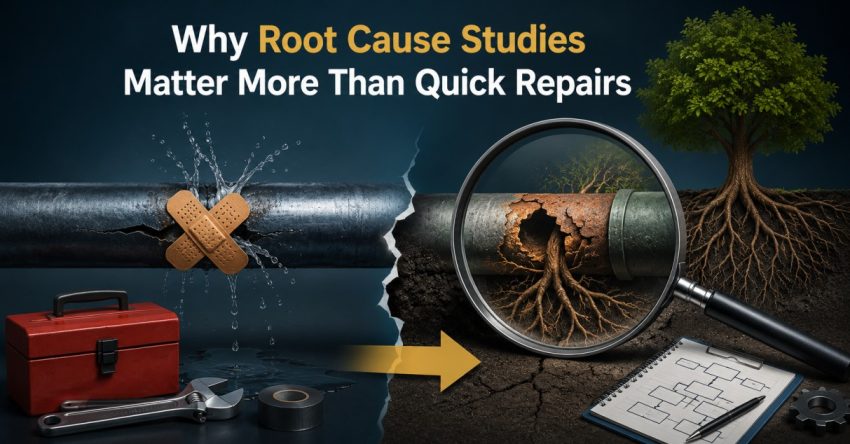
In case when the equipment breaks down, the systems fail, or operational problems emerge, the primary solution that people come up with tends to be fixing the obvious problem immediately. Despite the fact that such repairs can resolve the problem on the spot and bring back the normal operation of the facility, they do not actually tackle the real reason of the breakdown. This is the reason why root cause study is extremely important in the field of maintenance, engineering, manufacturing, and facility management.
Looking Beyond the Immediate Problem
Fixing the problem immediately is a strategy aimed at restoring the normal operation with the minimum delay. However, despite the fact that such a strategy can work in an emergency situation, it does not always deal with the cause of the problem itself. In other words, if the part of the equipment breaks, then it should be replaced; however, if the reason behind the failure is the excessive vibration, wrong installation, or overloading of electrical systems, the problem will emerge once again. Root cause studies explore all the factors which led to an incident.
Long-term Maintenance Cost Reduction
Recurring maintenance may be costly. When there are frequent equipment breakdowns, maintenance costs increase along with labor, spare parts costs, and losses due to production downtime. In several industries, such an interruption may mean financial losses and unsatisfied customers.
Root cause studies prevent the recurrence of failures and minimize maintenance efforts. By addressing the cause, companies will have the opportunity to extend the life of their machinery, increase efficiency, and properly use their maintenance budget.
Analysis of the problem is often much more cost-efficient than handling emergency situations all the time.
Enhancing Safety and Reliability
Most cases of equipment malfunction may pose safety hazards to workers, clients, and neighboring communities. Electrical malfunctions, structural weaknesses, pipeline leakage, and machinery breakdowns, among others, may have dire consequences when not addressed by identifying the actual cause of the problem.
Conducting root cause analysis helps to discover potential weaknesses in the system, which might in the future result in an accident. The system then becomes safer once such weak spots are addressed.
It is clear from the above explanation why organizations need to conduct root cause studies.
Helping to Make Improved Decisions
Information collected through the process of root cause studies helps management and engineering to make good decisions concerning the upgrades, maintenance, procedures, and training of staff. This is done using measurable information rather than assumptions.
This information will help in improving future design projects. Information collected from the one failure case will be used in preventing failures in other plants or facilities.
This will lead to the creation of strong infrastructure and performing systems.
Conclusion
Even though there may be instances where fast repairs are required to get back to normal functioning, it should never serve as an alternative for a study on why these failures happen. The analysis of root causes offers sustainable benefits in terms of detecting the real causes, avoiding failures from repeating themselves, lowering costs of maintenance, increasing safety levels, and boosting reliability of the system. Companies that understand the real reason behind failures avoid the need to patch up things temporarily and improve their performance significantly.
Also Read: Power Distribution Engineering Design for High-Density Urban Loads