
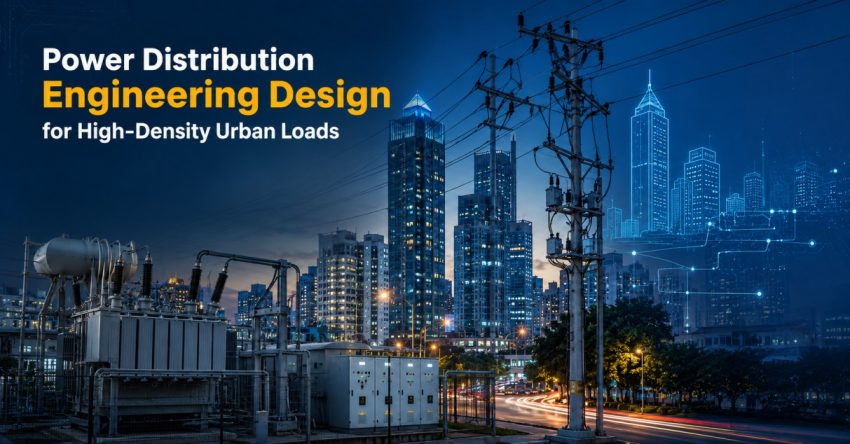
With the increase in urbanization, there is an urgent need for reliable and effective electricity. Modern cities have residential high-rises, office buildings, IT centers, hospitals, transport networks, and many other establishments that need constant power supply. Meeting these growing demands requires careful power distribution engineering design that ensures safety, efficiency, and long-term reliability.
High-Density Urban Power Demand
A high density of urban area implies the high rate of consumption of electricity in the limited geographical territory. A number of buildings and businesses create great load to the distribution network, which may not be able to cope with it. That is why advanced engineering design is needed to prevent from overloading and power supply interruption.
The engineers should correctly predict current and future electricity demand taking into account the population growth, technological innovations, and change in electricity consumption patterns.
Designing Reliable Distribution Networks
The design process for reliable power distribution engineering is started by performing load analysis and network design. Engineers find out how to route the lines, substations, transformers, and switchgear in such a way to enable the safe distribution of electricity within densely populated areas.
Redundancy is crucial when developing power systems in cities. It enables engineers to develop several ways to deliver electricity, so if there is an issue in one part of the network, the other paths will allow electricity to reach its destination.
Another technique used to distribute electricity is laying underground cables. Although this option is costlier than using overhead lines, it is more reliable and requires less maintenance work.
Technologies Make Performance Effective
Modern urban settlements widely use digital technologies that help to enhance electricity distribution. Automated switches, sensors, and monitoring tools allow noticing any fault and restoring services more efficiently compared to manual ways of performing those tasks.
Moreover, advanced monitoring allows engineers to notice overload in certain devices and prevent future breakdowns due to using data obtained with the help of smart grid technologies.
In addition, automation also allows balancing electrical loads in various parts of distribution network to ensure stable voltages even at times of high load.
Engineering to Support Sustainable Urban Development
The power distribution engineering designs should now consider sustainable energy options including rooftop solar panels, battery systems, and charging stations for electrical vehicles. The challenge with using this kind of energy is that the direction of electricity flow is not just unidirectional but also multidirectional.
Designing distribution networks that can incorporate sustainable energy without compromising on grid stability will require engineers to apply smart protection systems, voltage control equipment, and modern control technology. Energy efficiency should also be considered in the form of efficient conductor and transformer sizing.
Conclusion
In view of the growing pace of urbanization, it is imperative to have an intelligent electrical system that can provide power reliably under changing circumstances. Creating power distribution engineering designs involves proper planning, technology, architecture, and sustainable measures in order to cater to the requirements of the modern city. As the population increases and demands for electricity rise, such well-designed systems would be important to ensure safety and reliability of power supply.
Also Read: The Impact of Installation Conditions on Cable Current Carrying Capacity