
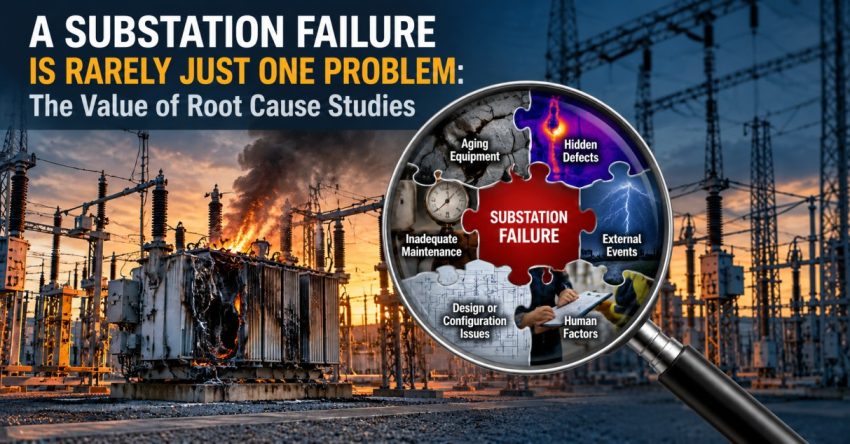
From the outside, a substation failure might seem simple: a breaker trips, a transformer is tripped, or a feeder suddenly goes off-line. But, the obvious problem is frequently a culmination of multiple conditions. All of the above can be involved in the same event. That’s where root cause studies come in handy. They do not just look at the failed component, they assist engineers in piece assembling the series of events and discovering the reason why the failure occurred in the first place.
Looking Beyond the Immediate Fault
The initial goal of an unexpected outage at a substation is typically to get the power back up and running safely. After the initial problem is solved, further investigation is necessary.
A relay failure or a breaker or transformer failure may be repaired or replaced, and power may be restored, but the incident may still not be understood. When the underlying condition persists, it may happen again.
Root Cause Studies are a structured way to investigate the full failure situation. By examining the equipment used, the conditions under which it was operated, the response to the protection, maintenance history, inspection records, etc, engineers can get a better idea of the situation.
There can be many causes of a single failure
Substation systems consist of equipment that is interconnected, and failures can occur in a number of ways.
For instance, the first reaction to a transformer trip might be that it is a piece of equipment issue. Further investigation might show that the overloading, insufficient cooling, worn insulation or a combination of these factors is the root cause of the overheating. Likewise, anything from protection settings, instrumentation, wiring, external faults, or communication can be a breaker operation.
This is why Root Cause Studies must be able to make the distinction between the symptom, immediate cause, contributing factors, and root cause. It is important for engineers to know about these layers to avoid prematurely concluding the investigation.
Experience gained from protection events
Protection systems play a significant role in providing valuable information during incidents at the substation. Relay data, trip indications, fault data and event logs can be used to determine what occurred just prior to and during an outage.
In analyzing all this information along with equipment condition and operating history, it can be determined if the protection actually operated properly or if some unexpected operation caused the event.
A comprehensive investigation can then provide valuable information regarding system behaviour, equipment condition and potentially areas of weakness, from that single protection event.
From Investigation to Prevention
The true benefit of Root Cause Studies is that the findings are followed by corrective and preventive actions.
The actions can range from adjusting maintenance plans, to checking out similar equipment or reviewing protection settings, to reviewing existing monitoring processes, to replacing aging equipment, to modifying operating procedures, and even to addressing design limitations.
It is important to make a point of not restricting lessons to the failed equipment all of the time. The investigation may be the chance to address any other vulnerability that might exist elsewhere in the substation before it turns into another outage.
Strengthening Substation Reliability
New substations should be capable of reliable performance under varying electrical and environmental conditions. Addressing failures on the spot can result in the failure to deal with the same issues again.
Root cause studies aid in a more proactive/reliability strategy by assisting the engineering team in understanding patterns of repeated trips, equipment failures and unexpected interruptions. They also build a knowledge base that can aid in making future maintenance and design reviews and operational decisions.
Conclusion
When there is a failure at a substation it is not usually a single failure. The fault can be a chain of technical, operational, environmental and maintenance causes, which are not necessarily easily seen. Root cause studies can assist engineers in following that chain, distinguishing between symptoms and underlying causes, and determine actions to prevent recurrence. When substation operators respond to each major failure as a learning experience, they can go beyond a service restoration and work to create a more reliable, safer, and more resilient system for future operations.
Also Read: The Hidden Risk of Undersized Cables: Why Cable Current Carrying Capacity Matters