
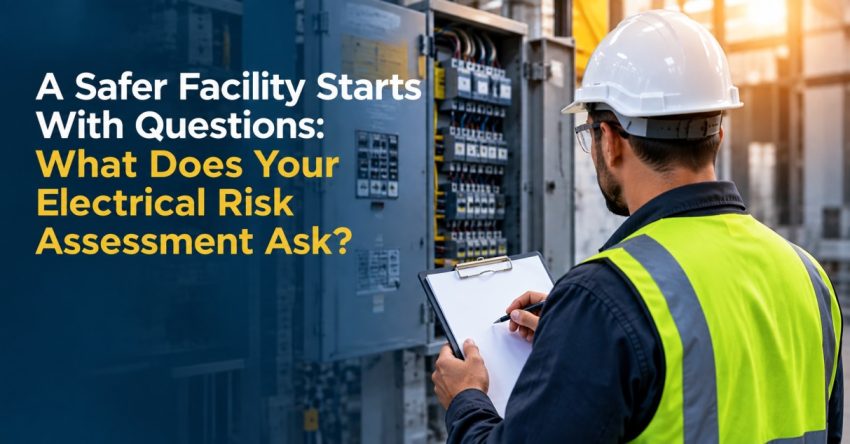
From manufacturing plants to commercial buildings, from data centers to industrial sites, electrical systems are pivotal to almost any facility that is built in modern times. However, hazards may lie behind the reliable power distribution and be hard to spot in normal operation. Overloaded circuits, aging equipment, lack of protection and unexpected fault conditions can all pose serious safety issues. This is where an electrical risk assessment can be helpful as it enables an organization to raise the right questions before electrical hazards become a costly incident.
What Could Go Wrong?
The first question which is easy enough to ask and is critical is, what are the electrical hazards present in the premises?
An Electrical Risk Assessment is not just about the obvious issues and it takes into account the way electrical equipment, electrical distribution systems and operating conditions could be a source of risk. Exposed energised parts, damaged equipment, damaged connections, lack of protection and conditions that may result in electrical faults can be potential concerns.
These hazards can be identified at an early stage and organizations can priorities areas that need to be addressed.
What are the likely spots where people are being exposed?
The risk around electrical equipment is not a standalone risk. The extent of risk may be greatly dependent on the employees’ tasks and place of work.
An electrical risk assessment includes equipment operation, inspection, testing, troubleshooting and maintenance. It can be used to identify where staff might encounter electrical risks and if the current procedures and controls are sufficient to mitigate these risks.
To create practical safety measures, there needs to be an understanding of the interaction between people and electrical systems.
Does the Electrical System have the necessary protection?
One major consideration is what happens if something goes wrong, can protective equipment react appropriately?
Circuit breakers, fuses, protective relays or other devices are designed to sense abnormal electrical conditions and prevent the effects of these conditions. Their performance can be compromised, however, by incorrect settings, aged components or changes to the electrical network.
A review of protection arrangements as part of an Electrical Risk Assessment may assist in identifying any potential weaknesses and make it apparent that other engineering evaluation may be needed.
Have the System changed?
An electrical network changes its structure over time. Machinery is added to facilities, loads are increased, new distribution equipment is installed and existing circuits are modified.
However, with each change, the flow of electricity through the system could change.
Therefore a risk assessment should address the question of whether there is an accurate representation of the facility in the current electrical documentation. The drawings may be obsolete, and information about the equipment and/or system data may be incorrect or out of date, which can negatively impact the ability to understand actual working conditions and potential hazards.
What Controls are already in place?
Risk assessment is not just a search for problems! It also explores how current controls minimize exposure.
These controls can include equipment guarding, isolation practices, warning signs, restricted access, PPE, training and safe operating practices. The assessment can be used to check if the measures are suitable for the hazards identified.
If controls are inadequate, organisations may choose to prioritize improvements for control in line with the risk level.
During an Emergency, What happens?
Abnormal and emergency conditions should be a part of a good electrical risk assessment.
What if equipment breaks? Does power need to be isolated rapidly? Is there employee familiarity with response? Have the emergency procedure been defined clearly? These are the questions that can potentially uncover weaknesses which may go unnoticed otherwise.
Practicing for the unusual can help minimize confusion and response to an electrical incident.
Conclusion
Safety starts with the facilities themselves, but it doesn’t stop there. It starts with asking the right questions of hazard, exposure, protection, system changes and emergency response. An electrical risk assessment can be an effective tool in determining these areas and opportunities for improvement. Risk assessment, if combined with correct electrical knowledge, good engineering practices and effective safety controls, can assist any organisation in making their working environment safer and more reliable.
Also Read: When Electricity Turns Fatal: Understanding Risk Through an Arc Flash Study