
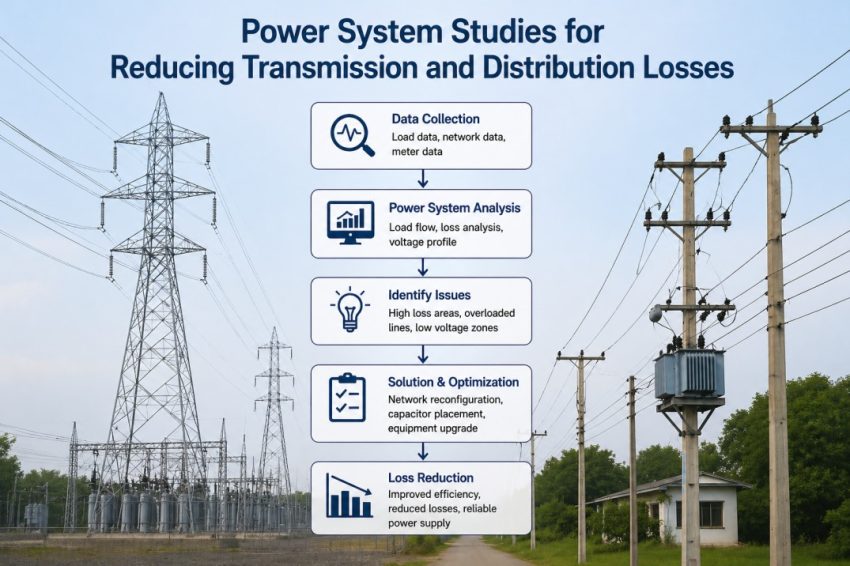
In the modern energy environment, reducing transmission and distribution (T&D) losses is a top priority for both utilities and industries. These losses do not only affect the efficiency of operations, but also increase the costs and lower the total power supply. Comprehensive Power System Studies are one of the most efficient means to manage this difficulty as they give data-driven information about the system performance and optimization possibilities.
Understanding Transmission and Distribution Losses
Transmission and distribution losses occur when electrical energy that is converted to heat because of resistance in conductors, transformers and other network elements. There are broadly classified losses as technical and non-technical losses. The technical losses are due to inefficiencies of the systems and non-technical losses are due to power theft or inaccuracies of the meter.
In order to effectively deal with these challenges, utilities use Power System Studies to determine the areas that are prone to losses and take corrective actions.
Role of Load Flow Analysis
One of the basic elements of system evaluation is the load flow analysis. It assists in the determination of the voltage levels, current flow, and the power distribution throughout the network. An analysis of these parameters enables the engineers to identify overloaded lines, voltage drops, and inefficient power routing.
Organizations can also optimize the network configurations and balance loads, and minimize the unnecessary dissipation of energy through detailed Power System Studies. This will make sure that power is made more efficient between generation sources and the final consumers.
Importance of Network Optimization
The network design is an essential aspect of minimizing losses. Systems that are poorly designed with excessive transmission lines or incorrect conductor sizes can contribute greatly to energy waste. Power System Studies allow engineers to model different network situations and determine the most efficient ones.
For example, the re-configuration of feeder lines, transformer upgrading or the installation of capacitor banks can help to increase power factor and minimize losses. Such specific interventions can only be achieved with effective and in-depth analysis of the system.
Integration of Advanced Technologies
The effectiveness of loss reduction strategies has been improved with modern technologies like smart grids, advanced metering infrastructure (AMI) and real-time monitoring systems. These tools will give real-time data, and dynamic adjustments of the system can be made.
These technologies together with Power System Studies assist utilities to identify anomalies, foresee possible failures, and take corrective actions in time. This is a proactive measure that not only minimizes losses but also enhances the overall system reliability.
Addressing Non-Technical Losses
Although technical advances are key, non-technical losses cannot be ignored. Revenue can also be greatly affected by theft of power, faulty meters and inefficiency in billing. Through consumption analysis and discrepancies, Power System Studies can aid in the detection of abnormalities and assist in enforcement efforts.
These losses could be further cut by implementing more accurate metering and more stringent monitoring systems to help make the power distribution system more transparent and efficient.
Conclusion
It is crucial to reduce transmission and distribution losses to attain energy efficiency and sustainability. Through the detailed Power System Studies, utilities and organizations can learn more about how their systems perform, how they can optimize their infrastructure, and embrace new technologies. These initiatives reduce the costs of operation, as well as providing a stable and efficient power supply, which are beneficial to the providers and consumers in the long term.
Also Read: How Root Cause Studies Help Prevent Recurring Problems