
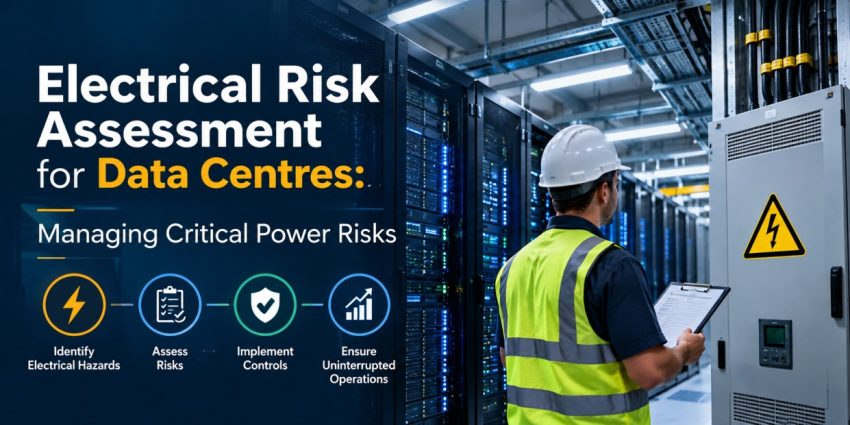
It is very important that the power supplied to a data centre is reliable and stable to ensure servers are available and reliable, protecting valuable information and providing continuous digital services. Any interruption in power could have a business impact, on cloud services and customer access. With facilities growing and the need for more power, it becomes critical to locate electrical hazards. An Electrical Risk Assessment is used by data centre operators to assess risks of failure, their impact and the appropriate steps they can take to make their power reliability and electrical safety more robust.
Data centres are complex and contain many types of equipment to manage the power, including transformers, switch gear, UPS units, generators, PDUs and back-up circuits. If any of these fail it can affect how the equipment is operating.
Electrical Risk Assessment helps to discover vulnerabilities in advance to prevent damage to equipment, outages, or safety events. It also enables facility managers to focus on the corrective actions that are most likely to occur and have the greatest impact on the facility’s electrical systems.
Key Electrical Risks in Data Centres
When considering power infrastructure in a data centre, there are a number of electrical hazards to consider.
Failure of power distribution; faulty power connection, overloaded circuits and damaged components can cause critical equipment loss of power.
- Power failures – Poor connections, over loading circuits and faulty components can cause a disruption in the supply of power to vital machinery.
- UPS and Battery issues – Poor battery performance, improper maintenance and faulty equipment will cause an issue with no backup power.
- Short circuits and electrical failures – Faulty insulation, faulty wiring and faulty components can cause faults.
- Improper earthing – Improper earthing can cause risk of electric shocks, damage to equipment and faults.
- Over heating – Loose connections, over loading and faulty components can cause over heating.
These issues are picked up in the early stages so that any vulnerabilities can be prevented and fixed to avoid any issues to critical infrastructure.
Applying the Critical Power System concept to evaluate
The Electrical Risk Assessment should cover the entire power supply chain, from the incoming utility power to the equipment racks housing IT equipment.
The assessment should include: ability of electrical systems to carry current and expected loads, proper operation of protective devices, backup arrangements of protection.
When assessing, consider the following areas:
- Electrical Demand, Load, and Balance of Circuits and Distribution Equipment Capacity
- Backup Power Supply System: Test the performance of UPS, battery, and generator along with power switching
- Protection Coordination: Verify whether the circuit breakers, fuses and other protection devices are appropriate and correctly coordinated to isolate the fault.
- Redundancy and Resilience: Evaluate whether there are multiple power lines and one failure will have an adverse impact on critical services
- Maintenance and Monitoring: Evaluate whether there is inspection history, equipment condition and alarms to identify any emerging problem
These tests will decide whether the power system can handle the potential electrical problems in the future.
The value of Risk Assessment in minimizing downtime
An electrical risk assessment can be used to detect existing defects or potential issues. It further allows facility managers to comprehend the possible impact of failure of one or more systems on connected systems.
A single issue with a common switchboard located upstream could impact a number of power distribution routes even with redundant UPS systems in place in a data centre. Likewise, maintenance operations may pose a threat if equipment isolation and switching is deficient.
A structured assessment will aid operators:
- Determine single point failure in critical power systems.
- Focus the inspection/replacement of high-risk equipment.
- Optimize the preventive maintenance plan.
- Re-review emergency response and electric isolation procedures.
- Design enhancements to meet capacity and operational risk needs.
These measures can increase resilience, while minimizing the risk of downtime.
Assessment as an ongoing safety management activity
As data centres expand by introducing servers, adding extra racks, or upgrading the power distribution systems, electrical risks can also evolve. The risk of an assessment made a few years ago being out of sync with operating conditions is high.
Therefore, facility managers should also assess electrical risks when there is a major change in the equipment, a capacity upgrade, significant fault or changes to the power distribution systems. Review of this type is also critical to ensure that current controls continue to be effective.
Assessments can vary depending on the facility and may include load-flow analysis, short-circuit studies, protection coordination studies, arc-flash assessments, and thermal inspections. The following activities are used to supplement information about system performance and specific electrical hazards.
Conclusion
Electrical reliability is essential to data centre operations – a localized failure may have far-reaching implications for both service reliability and equipment safety. An electrical risk assessment can be conducted as a systematical process to identify weaknesses, assess critical power systems and prioritize corrective measures. Data centre operators can enhance electrical safety and minimise unwanted downtime, by using technical analysis, routine inspections, suitable protection and proper maintenance. Periodic retesting also ensures that power infrastructure continues to serve a variety of changing operational demands.
Also Read: Why Accurate Electrical Models Matter in Power System Studies