
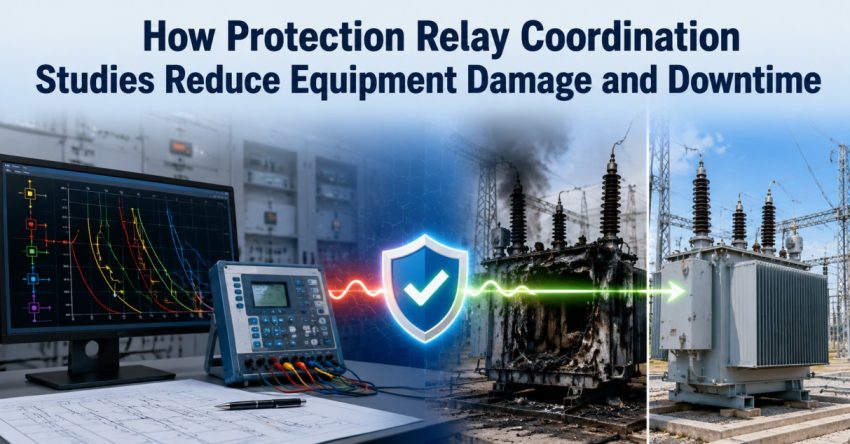
Power systems are an essential component in any industrial plant, commercial building, utility, or civil engineering project. A problem in any of the mentioned electrical systems would result in damage to equipment, loss of productivity, accidents, and increased cost of doing business. To reduce these possibilities, companies make use of protection relay coordination studies. The purpose of conducting such studies is to ensure proper operation of protective devices in terms of timing and order when responding to electrical problems.
What is Protection Relay Coordination?
Relay devices are meant to detect abnormalities in power systems including short circuits, overload conditions, and ground faults. Whenever there is any of these faults, relays communicate to circuit breakers, which in turn remove the faulty part of the electrical system from the power system.
In a protection relay coordination study, the performance and settings of protective relays throughout the whole power system are analyzed. The key idea behind this process is making sure that only the protective device nearest to the fault acts, while the remaining ones continue their normal operation.
Avoiding Severe Damage to Equipment
Electrical problems often cause high current levels, which have the ability to cause extensive damage to transformers, motors, generators, cables, and switchgears. However, in cases where the protective devices do not react fast enough or work correctly, there is the possibility that the fault will last longer than necessary.
Coordination studies of protection relays are very important as they help decide on the most appropriate relay settings for various faults. When the relays are properly coordinated, they are able to detect faults quickly and isolate any damaged equipment. By doing this, one will be able to limit the damages done by the fault.
Reducing Unplanned Downtime
Downtime is potentially very costly, particularly for businesses whose operations cannot be interrupted without severe ramifications. Manufacturing firms, IT service providers, hospitals, utilities, and other companies must rely on their electrical infrastructure to deliver efficient and uninterrupted services.
In the absence of appropriate coordination, an electrical fault in one location will result in several protective equipment being activated, thereby leading to unnecessary interruptions in power supply despite the fault affecting only a small part of the network.
Protection Relay Coordination Study ensures that faults are confined to the smallest area possible by minimizing power outages. This helps businesses maintain their operations and minimize any potential production downtime.
Improving Workplace Safety
Any electrical fault that occurs in the plant poses a serious safety concern for people working around the live equipment. Such events like an arc flash, explosion, and fires can occur when faults are not cleared in time or using the correct setting of protection relays.
A proper study of protection relay coordination can increase safety within the workplace. Faults that happen can be isolated within a shorter period, reducing the energy that is released. Improved safety improves the working conditions and operations at the plant.
Growing and Evolving the Electrical System
Over time, a facility experiences growth due to increased load demand. It can also have other issues like equipment upgrades, addition of more equipment, and the introduction of alternative energy sources.
A periodic review of the protection relay system through coordination studies will help companies evolve their systems while maintaining the reliability of the system.
Conclusion
The undertaking of protection relay coordination studies is an integral component of electrical systems management. Protection relay coordination studies play a critical role in enhancing the efficiency of the operation and protection of electrical equipment through the correct functioning of protection relays. These types of studies enable organizations to enhance their system reliability by ensuring that protection relay schemes change with changes in system conditions.
Also Read: Reducing Critical System Failures through Fault Tree Analysis