
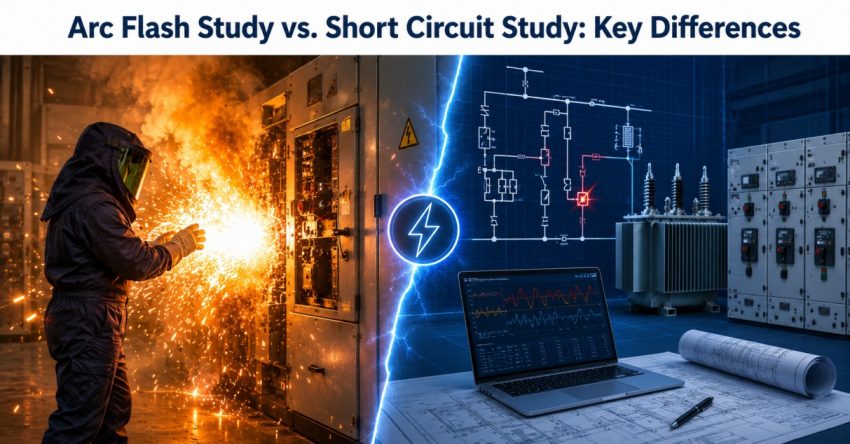
Power systems have been designed to function safely and effectively even when subjected to various environments. Unfortunately, the occurrence of some faults like equipment malfunctioning, insulation damage, or inadvertent contact may expose the personnel and systems to dangerous scenarios. Some of the analyses that are very critical in enhancing the safety of an electrical system include the Arc Flash Analysis and the Short Circuit Study. Although these two analyses are quite similar, each is unique in its way.
What Is a Short Circuit Study?
A Short Circuit Study analyses the level of fault current that would occur in the electrical system due to the existence of an abnormality in the system, for instance, phase to phase and phase to ground faults. The main purpose of a Short Circuit Study is to identify if electrical equipment, such as circuit breakers, transformers, switchgear, and other electrical equipment, will be able to endure fault currents without any problem.
Through the use of mathematical analysis, engineers can establish the maximum and minimum fault currents at various places within the system. This process assists in confirming the rating of the equipment and in ensuring that the protection devices are coordinated accordingly.
If an electrical system is not subjected to a Short Circuit Study, the electrical equipment will be subjected to fault currents that are higher than the equipment design.
What Is an Arc Flash Study?
The Arc Flash Study is concerned with identifying risks associated with electrical arcs that occur between energized conductors or conductors and earth. This results in very high temperatures, explosions, molten metals, and bright flashes of light capable of causing harm to personnel carrying out maintenance operations or using electrical equipment.
Based on information gained from the Short Circuit Study, engineers determine the levels of incident energy that would come into contact with personnel in the case of an arc flash occurrence. From the information gathered, they are able to recommend the level of PPE, safe working distances, and labeling of equipment. The main objective of the Arc Flash Study is to ensure personnel safety.
Differences between the two types of studies
While both Short Circuit Study and Arc Flash Study deal with electrical faults, there are some differences in their purposes. The goal of the Short Circuit Study is to protect electrical devices and ensure fault current capability. It analyses equipment rating and fault level and checks the operation of protective devices.
The purpose of an Arc Flash Study is different; it deals with the issue of employees’ safety. This study analyzes the amount of energy that may be released during arc flash and recommends about PPE, work methods and marking hazards.
One more difference is that the results of an Arc Flash Study depend on the results of a Short Circuit Study. Fault current calculation is an important step of arc flash assessment.
Reasons Why Both Studies Are Important
Safety in electrical systems cannot depend on only one kind of analysis. For example, even if an electrical system is correctly rated, it may be unsafe because the protective devices act too slowly or there is a lot of incident energy. The same is true about Arc Flash Safety – it can be provided only when one knows how much fault current is available in his system.
Carrying out both studies allows organizations to follow the industry standards, increase reliability of their equipment and minimize the risks.
Conclusion
It is very important to distinguish two kinds of study because both Arc Flash Study and Short Circuit Study are very important for the electrical systems but they solve two different problems. Short Circuit Study makes sure that the system can tolerate and interrupt fault current, while Arc Flash Study provides protection to employees from electrical arcs.
Also Read: Fault Tree Analysis in Aerospace, Automotive & Manufacturing