
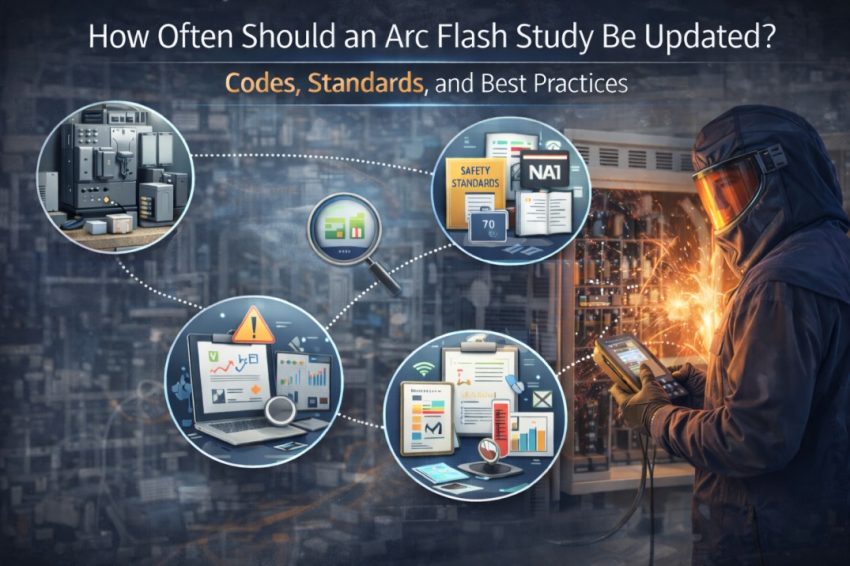
Electrical safety is a critical concern in industrial, commercial, and utility environments. Conducting an arc flash study is one of the effective methods for mitigating electrical hazards. Nevertheless, it is not sufficient to conduct the study once. In order to maintain the continued safety, compliance, and accuracy organizations must understand how often an arc flash study should be updated and what standards guide this process.
Why Updating an Arc Flash Study Is Important
An arc flash study evaluates the potential energy that is emitted in an arc flash event and assists in determining the safe working distance, proper personal protective equipment (PPE), and warning signs. Electrical systems on their own will undergo changes over time as a result of equipment upgrades, loads, maintenance work or operational extensions. In case of such changes, the initial calculations might not be an indication of real risk levels. An outdated arc flash study can lead to incorrect PPE selection and increased danger for workers.
Constant updates also mean that decisions that are made about safety are not made out of assumptions but according to the current conditions of the system.
Codes and Standards Governing Arc Flash Study Updates
Industry standards clearly describe update requirements. The most popular electrical safety standard, NFPA 70E, suggests that an arc flash study should be reexamined at least every five years. This review can be used to confirm that data of the system, fault currents, and settings of the protective equipment are correct.
Besides time-based reviews, NFPA 70E and IEEE standards emphasize updates whenever significant electrical changes occur. These standards do not consider arc flash assessment as a document but a living safety tool that should change with the system.
Situations That Require Immediate Updates
Beyond the five-year guideline, there are several scenarios where an arc flash study should be updated immediately. These include the installation of new electrical equipment, replacement of circuit breaker/relays, utility supply change, or replacement of coordination of protective devices. A minor variation in the size of the transformers or length of the feeders can significantly affect arc flash incident energy levels.
The additions of facilities, equipment, and the increase of loads should also be reassessed. Ignoring these changes can invalidate arc flash labels and compromise worker safety.
Best Practices for Maintaining Arc Flash Accuracy
Organizations ought to be proactive in order to ensure compliance and safety. Keeping detailed records of electrical modifications makes it easier to determine when updates are needed. Another practice that will help is scheduling periodic reviews as well as audits of maintenance.
One should also consider hiring qualified electrical engineers to know the existing standards and software tools. New analysis methods can be used for a faster calculation and more accurate results, and it is easy to update it regularly. An up-to-date arc flash study is also a supporting factor for training programs; ensuring employees understand risks and protective measures.
Conclusion
An arc flash study is not a one-time exercise but an ongoing commitment to electrical safety. The industry standards suggest that it should be reviewed after every five years or as a result of changes in the system. Codes, monitoring modifications and best practices can help organizations to make sure that their arc flash study is accurate, compliant and effective. Finally, timely updates safeguard workers, minimize the liability, and maintain a high-level safety culture.
Also Read: Role of Data, Metrics, and Statistical Tools in Reliability Studies