
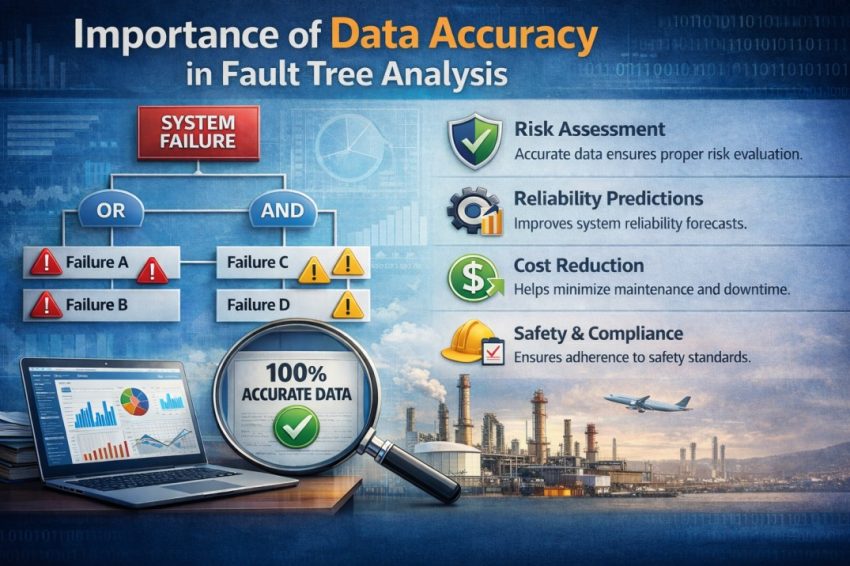
To be safe and efficient, it is crucial to determine the possible failures in any system or process. It is here that the fault tree analysis comes in handy. It assists in breaking down the complex systems in order to realize the underlying causes of failures. Nevertheless, there is one major factor that determines the effectiveness of Fault Tree Analysis and it is the data accuracy. Even the most properly organized analysis can give false conclusions without the correct data.
Learning about the Function of Data in Analysis
Fault Tree Analysis is based on data, which then maps the potential failure routes. This data contains the information concerning the components of the system, previous failures, working conditions, and probabilities. With the correct data provided in fault tree analysis it is easier to detect actual risks and preventive measures.
Conversely, wrong or incomplete information may give a false lead to the whole process. It can be emphasizing the wrong reasons or it can fail to detect the crucial failure points lowering the stability of the analysis.
Influence on Risk Identification
Fault Tree Analysis is also used to spot risks in advance. There is correct data used to guarantee that every possible failure scenario is taken into account. It assists in ranking risks according to their probability and consequences.
In case of unreliable data, there are chances that certain risks will be underestimated and other risks will be overestimated. This imbalance has the potential of making bad decisions and ineffective risk management plans.
Decision-Making with Real-Time Data
The fault tree analysis is often used in engineering and management in decision-making. In case of accurate data, the analysis will provide a clear picture of the possible issues and their reasons.
This enables organizations to make the right corrective measures at the right time. Credible information assists informed decision-making, minimizes uncertainty, and enhances the overall performance of the system.
Enhancing System Reliability
Accurate data plays a major role in improving system reliability. Fault Tree Analysis is useful in determining weakly where there are weak points in a system, although only when the input data are real conditions.
Having accurate data, organizations can pay attention to the real issues and not wasting time and resources, they can concentrate on the real problem. This will result in greater performance, reduced failures and more confidence of the system.
Reducing Costs and Avoiding Rework
Any faulty data used in fault tree analysis can cost a lot. Right data assists in addressing the right issues at the initial stage. This saves time and money in the long run as it saves time and rework.
Significance of Data Validation
The data used in Fault Tree Analysis should be validated to obtain accuracy. This involves checking of sources, revising old information and comparing with actual observations.
Periodic data validation enhances the quality of analysis and the results are applicable in the long run. It also helps to establish confidence in the process and its results.
Conclusion
Fault Tree Analysis is an effective tool to detect and control a system failure, but its effectiveness is dependent on the quality of used data. Quality data leads to improved risk identification, informed decision-making and increased reliability of the system.
Fault Tree Analysis can be optimally utilized by organizations that pay attention to high data accuracy. They can minimize risks, manage costs and improve operational results by investing in quality data collection and validation.
Also Read: Arc Flash Study: Turning Electrical Data into Life-Saving Insights