
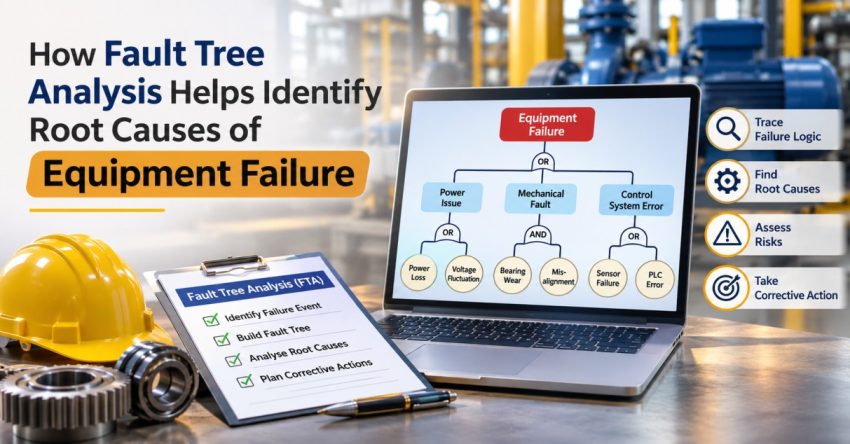
Equipment fails can result into a lot of issues within industries. This will cause disruptions to production, increased maintenance costs and safety issues. Whilst fixing the broken equipment will help, it is important to know the reasons behind why it has failed. Using fault tree analysis (FTA) you can investigate what could have caused the failure. FTA helps you to analyse what could have caused failure, by using logical gates you can understand how different failures can cause an undesired events. This can help industries to understand the root causes and then make informed decisions on maintenance, safety and reliability.
Understanding Fault Tree Analysis
Fault Tree Analysis is a systematic risk assessment tool to determine the possible causes of a specific failure in a system. The top down analysis starts with an undesired event which is called the ‘top event’.
Using logical gates such as AND & OR will help you to determine the links between each failure. For example if a machine breaks down it could be due to; electrical issues, mechanical damage, lubrication issues or multiple failure reasons.
This helps the maintenance and engineering team understand how failures with individual components can impact the overall system.
How Fault Tree Analysis Can be Used to Determine the Cause/s of Equipment Failures
Fault Tree Analysis is used to determine the cause/s of equipment failures by:
- Defining the failure: It is the failure that has occurred and needs fixing, such as equipment overheating, motors not working, problems in the power supply, unexpected equipment shutdown, etc.
- Determining Potential Causes: The causes for the problem will be identified here. There are many possible events that may be responsible for the failure to occur. It could be faulty equipment, incorrect installation, excessive operating temperature, power fluctuations, poor maintenance, etc.
- Identifying the Logical Relationship between Events: AND and OR gates will be used in order to establish logical relationships. An OR gate will help determine when any one of several events can cause the failure. AN AND gate will help determine when more than one condition should be present.
- Evaluation of the Contributing Factors: With this method, the engineers are able to look into the contributing factors, rather than just the apparent ones. They can look into individual components and operating conditions as well.
- Specify Preventive Actions: After identification of the causes, the engineers will be able to take necessary preventive actions.
Applications of Fault Tree Analysis In Industrial Maintenance
Fault tree analysis can be used in a variety of industries where equipment reliability is a key concern. In manufacturing environments it can help to understand why machinery is failing and causing disruption to production. In power generation and electrical environments it can help find the combination of faults happening within the system.
Industries that use pumps, compressors, turbines and other vital machinery can use fault tree analysis to help understand how failures occur.
With the use of historical maintenance and equipment data Fault Tree Analysis can also be used to improve reliability planning.
Benefits Of Using FTA For Equipment Reliability
One of the main benefits of using Fault Tree Analysis is that it helps encourage a more preventative approach. This allows organisations to understand what could cause failures to happen.
Other benefits are:
- Better understanding of equipment vulnerability
- Improved maintenance planning & resource allocation
- Reduced possibility of re-occurring equipment failures
- Improved safety within the workplace and processes
- More informed engineering and risk analysis decisions
Conclusion
The reliability of equipment is not only determined by how quickly they can be repaired but organisations should know the reasons why equipment fail so that effective strategies can be put in place to stop them failing. Fault Tree Analysis can provide a clear method to analyse failure events, determine the conditions which have caused it to fail and identify areas where corrective actions are needed. Adding this method to reliability engineering and maintenance planning will allow improvements to the performance of equipment, reduce unplanned downtime and create a safer and more reliable operation.
Also Read: Electrical Risk Assessment for Data Centres: Managing Critical Power Risks