
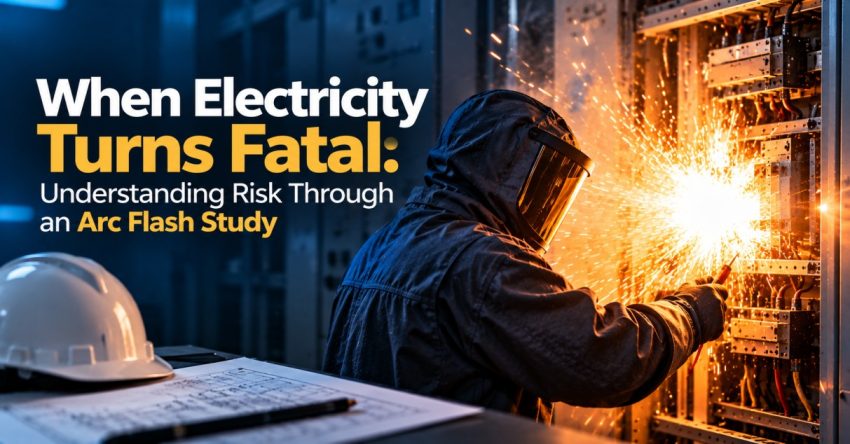
Most modern buildings are dependent on electric power, but systems that are running smoothly are very hazardous if there is a fault. In just a few seconds, an arc flash can generate extremely high pressure, light, heat and molten metal, posing a potential danger to workers around electrical equipment. It’s essential to know where and how these hazards can arise to educate yourself in electrical safety. An arc flash study can assist an organization in determining these risks and ultimately decide how to keep employees and equipment safe.
Why is an Arc Flash so Hazardous?
In an arc flash, an electrical circuit flows through an unintended path, typically in the air between energized conductors, or between a conductor and ground. This electrical arc can produce very high temperature and release energy very quickly.
The risk does not just extend to the electrical equipment itself. People working in the vicinity could be exposed to heat, strong light, pressure waves, flying objects, molten material. The severity of an incident may be dependent on the available fault current, the system configuration, equipment characteristics and the time it takes the protective devices to clear the fault.
Beyond the Electrical Panel
Electrical systems are networks of interconnected systems. Changes in conditions in one part of the system can affect conditions in other parts. Fault levels and/or incident-energy exposures may change if new transformers, generators, motors, cables, switchgear or protective-device settings are installed.
That’s why ratings on electrical equipment alone might not give a full picture of the risks in the workplace.
An arc flash study should analyze the electrical system, and, based on relevant system information, be able to understand what may be fault conditions and the associated arc flash hazards at applicable equipment.
The importance of Incident Energy
The incident energy is one of the most important factors taken into account when assessing arc flash hazards—the amount of energy that might be generated at a particular work location in the event of an arc flash.
Generally, a higher incident energy level means that workers may be subjected to higher exposures. The assessment can be used to determine equipment where further controls, engineering modifications or operating changes might be warranted.
It’s not just about creating a report. It’s meant to change electrical system information into real safety data.
Protective Devices Matter
Circuit breakers, fuses and other protective devices are significant factors in reducing the time of an electrical fault. The faster a fault is cleared out, the less energy will be released in an arc flash.
Therefore, an arc flash study can be implemented in conjunction with the short circuit and protective device coordination studies. These analyses can complement each other to understand the ability of an electrical system to perform in abnormal conditions.
This information may also indicate areas that warrant a review of protection settings and areas for possible coordination problems.
Keeping the Study Current
Electrical systems do not remain unchanged. Facilities to be upgraded with equipment, distribution network changes, load additions or device replacement are made routinely. Any major change may influence factors that were considered at a previous evaluation.
For this reason, an arc flash study should not be viewed as a one time, “set it and forget it” study, which will last a lifetime. Maintaining up-to-date electrical-system data and study models helps maintain an organization’s accurate understanding of potential hazards.
Conclusion
In an instant, a routine electrical job can become a life-threatening hazard due to an arc flash. Although there is no way to identify all electrical hazards, an arc flash study can help identify potential sources and ways to mitigate those risks. When coupled with the proper system information, engineering analysis, and safety measures, organisations can begin to take steps to prevent electrical incidents, rather than just responding to them when they happen.
Also Read: Quantitative vs. Qualitative Fault Tree Analysis: What Engineers Should Know