
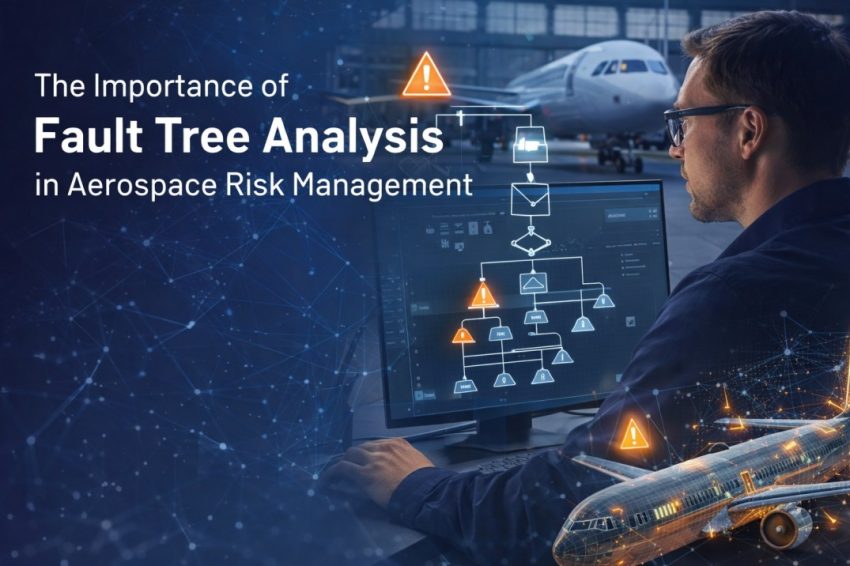
Aerospace industry is one of the complex and high-risk environments in the world. Aircraft systems are complicated and consist of thousands of components which need to operate accurately to have safe operations. A minor failure can have a severe repercussion, and this is the reason why risk management is an important aspect of aerospace engineering and operations. Fault tree analysis is one of the most effective tools that are used in understanding and management of such risks.
Fault tree analysis is a structured method that is employed in order to find out the potential causes of failure of the system. It assists engineers and risk managers to subdivide a significant failure occurrence into smaller influencing factors. Through these factors, in a systematic analysis, organizations would learn how various failures relate to each other and how such failures may contribute to a bigger issue. This practice ensures safety and reliability in the aerospace industry.
Aerospace Systems Risk understanding
Aircraft and spacecraft systems are complex in nature and comprise of engines, navigation systems, electronic controls, and structural systems. All these systems should be functioning properly. Nevertheless, system breakdowns may occur due to mechanical wear, human factor, software defects, or environmental factors.
It is here that fault tree analysis is useful. It enables engineers to visually graphically illustrate the manner in which various failures can converge to create a critical event. By establishing such links at the early stage, organizations may make preventive measures and minimize the chances of accidents.
The Fault Tree Analysis of Aerospace Risk management
In risk management within the aerospace industry, a fault tree analysis starts with the identification of a top-level event, which could be the engine malfunction or the loss of navigation. This event will be then divided into smaller possible causes by engineers with a logical structure. These reasons can be a defective component, a design defect, a mistake in maintenance or an operational mistake.
The logical relationships are then used to provide an analysis of the connection between these causes. To give an example, failure of the system may only take place when two different faults concur. Through these connections, engineers are able to get a better idea of the circumstances under which failure may occur.
Using the Fault Tree Analysis, the aerospace workers are able to assess the likelihood of various failure scenarios and to know which elements or procedures must be more heavily controlled.
Enhancing Aircraft Design and System Reliability
The fault tree analysis in the aerospace has had one of the greatest advantages such as its contribution to the design of a better system. Engineers can provide improvements to make systems more reliable when they determine the potential ways of failure that systems may experience during the design phase.
As an example, in case the analysis shows that certain component failure may result in dangerous system shut-down, designers may add redundancy systems or other safety measures. This is a proactive measure that will see aircraft systems being constructed in such a way that they have several layers of protection.
Fault tree analysis can also be utilized to reduce the risks, as well as to make the overall aircraft operation safer, by performing it in the very first stages of design.
Promoting Maintenance and Operational Safety
Fault Tree Analysis is also instrumental in maintenance planning other than in design. To verify that the systems are correct, aircraft have to be serviced and inspected on a routine basis. With the knowledge of the most critical components, the maintenance teams have the opportunity to prioritize inspection and preventive maintenance approaches.
As an illustration, when the analysis identifies some parts of the system as being the main causes of system failure, the aspects can be monitored more intently. This can be viewed as a maintenance process that helps to eliminate the chance of unforeseen failures and enhances the safety of operations.
Building a Strong Safety Culture in Aerospace Organizations
The aerospace industry has the highest level of safety as a priority. Risk management processes help organizations to safeguard passengers, crew, and equipment by investing a lot of resources to ensure safety. By introducing Fault Tree Analysis, this safety culture can be enhanced as systematic assessment of risks can be promoted.
Conclusion
The risk management of the aerospace industry involves proper planning, cutting-edge technology, and critical analysis. Fault tree analysis is a potent approach to explain how various failures might interact in order to form the critical events. It is used to enable engineers and risk managers to find possible issues before they arise by decomposing complex systems to manage small units.
Fault tree analysis Aerospace organizations can design better aircrafts, reinforce their maintenance policies, and ensure safety in the working environment through the fault tree analysis. This mode of analysis is important in the industry where precision and reliability are crucial since they can guarantee the safety and efficiency of aerospace operations.
Also Read: The Importance of Data Collection in Successful Root Cause Studies