


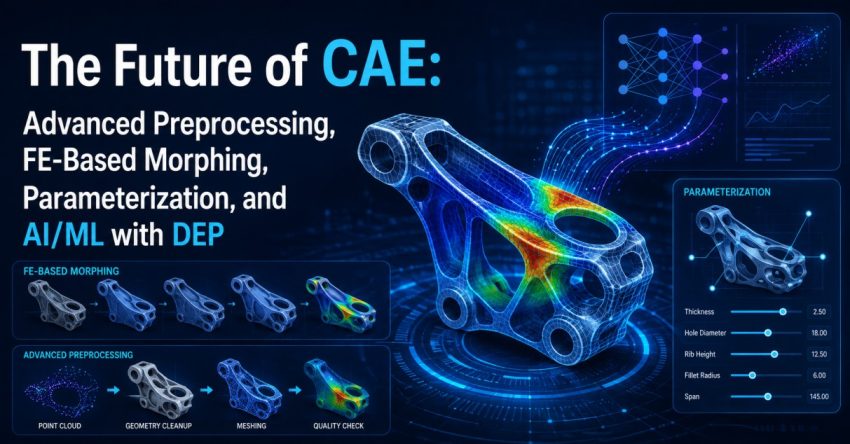
Computer-Aided Engineering (CAE) has become an integral component of the product development process and gives the engineer the opportunity to assess design, optimize performance, and decrease the necessity of creating physical prototypes. But with the greater sophistication of products, traditional simulation workflows sometimes find themselves unable to cope with design complexity and rapid development time. The future of CAE is intelligent automation, advanced model preparation and data-driven engineering. Detroit Engineered Products (DEP) is playing a key role in this transformation by leveraging the state-of-the-art preprocessing, FE-based morphing, parameterization, and AI/ML technologies to enhance engineering processes.
The Changing Landscape of CAE
Traditional CAE processes may be lengthy, especially for the pre-processing phase. Creating simulation ready models can be a time consuming process, involving lots of geometry cleaning, meshing and manual modifications. These repetitive tasks are time consuming engineering activities and delays product development.
Modern CAE platforms are increasingly turning to automation, and the engineers have less time to spend on model preparation and more time on design evaluations. DEP’s engineering solutions are designed to enable this change by simplifying key steps in the simulation process.
Advanced Preprocessing Improves Engineering Efficiency
Before starting to simulate anything, the first step is to preprocess. The quality of meshes and model preparation significantly affect the validity of the simulation results.
The advanced preprocessing capabilities provided by DEP assist engineers in making a few of the traditionally manual tasks automatic, such as geometry cleanup, mesh generation, model validation and quality checks. Engineering teams can speed up the preparation of complex simulation models, while ensuring consistency across projects, by reducing repetitive activities.
This efficiency is particularly useful in the case of multiple design iterations throughout the product development process.
FE-Based Morphing Accelerates Design Changes
Often, existing finite element (FE) models need to be modified for engineering projects. Having to rebuild simulation models from scratch for each design change can be costly.
To overcome this challenge, FE-based morphing enables engineers to change existing finite element meshes without losing simulation accuracy and quality of meshes. Design changes can be applied directly to existing validated models instead of models being recreated.
The ability to achieve this ensures faster design iterations, shorter validation time, and improved interaction between designers and simulation specialists.
Parameterization: Automated Design Exploration
There can be many design alternatives to consider when optimizing a product. This is not efficient and prone to error because of manual updates for each variation of design.
Parameterization can make this process easier by defining a set of parameters that are adjusted to create a variety of designs. Engineers can test various dimensions, materials and performance aspects without having to build models from scratch with each iteration.
With parameterization, a combination of optimization workflows can help organisations find improved performing designs, while simultaneously cutting engineering time.
AI and Machine Learning are driving Predictive Engineering.
Artificial Intelligence (AI) and Machine Learning (ML) are rapidly emerging as strong tools integrated into CAE workflows. These technologies are not intended to supplant traditional simulations, but instead are used in conjunction with traditional simulations and learn from the historical engineering data and simulation results.
DEP features AI/ML functionalities for predictive engineering, which allow for quicker design evaluations, trend identification and intelligent decision making. Engineers can estimate the performance result of a design quickly, prioritize interesting design concepts and minimize the number of expensive simulations during design.
This data-driven approach enables quicker innovation and engineering confidence.
Industry Adoption Continues to Grow
New generation CAE technologies are increasingly becoming part of the tools used by industries like automotive, aerospace, heavy equipment, and advanced manufacturing to stay competitive. With the ever-evolving nature of products becoming lighter, smarter and more complex, simulation platforms are expected to provide speed and accuracy for engineering teams.
Through advanced preprocessing, FE-based morphing, parameterization and AI/ML, organizations can reduce development times, enhance product quality and accelerate product innovation without compromising on engineering standards.
Conclusion
The future of CAE is defined Intelligence in automation, flexibility in simulation workflows and data-driven engineering. Detroit Engineered Products (DEP) is using advanced preprocessing, FE-based morphing, parameterization and AI/ML to assist organizations in keeping their engineering processes up-to-date and making well-informed, timely design decisions.
These next-generation CAE technologies will take a prominent role in enhancing engineering productivity, alleviating simulation bottlenecks and allowing more efficient product development in the many industrial sectors that are seeking to bring their products to market faster with more complexity.