


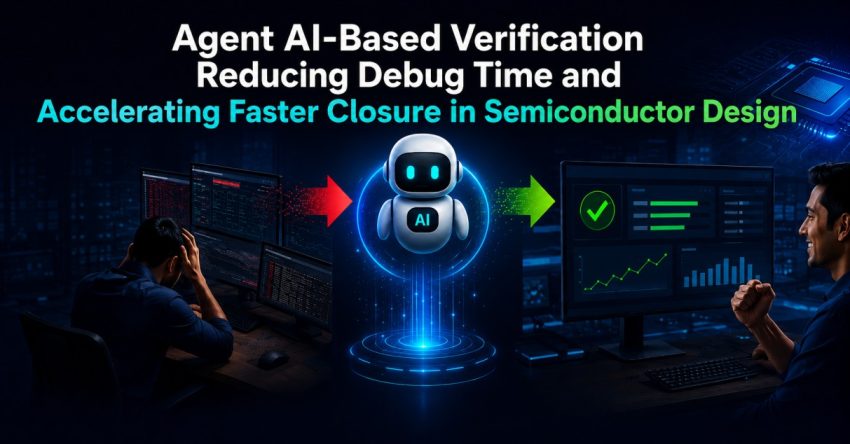
The growing complexity of the semiconductor chips has now rendered functional verification one of the most laborious stages in the design process. With ever-growing complexities and workload in verification, engineering teams seek out new methods for more efficient approaches to cut down the manual efforts without sacrificing any performance. Agent AI for functional verification is proving to be a realistic and effective approach that helps in automating repetitive tasks and accelerating closure.
Why Traditional Verification Faces Delays
A significant amount of the time verification engineers spend is in the activity of debugging the test case failures, wave form analysis, root cause analysis and repeating the verification process several times. The above processes can prove to be a bottleneck in terms of achieving coverage closure and extending the entire development timeline.
How Agent AI-Based Verification Improves the Process
The use of agent AI verification provides intelligent automation during the verification process by performing repetitive and time-consuming procedures. Engineers do not have to do everything manually but have the ability to rely on AI agents for constant analyzing the results of simulations, finding patterns and making decisions.
Among the most useful abilities of AI agents is automatic generation of verification infrastructure. The creation and maintenance of verification infrastructure become easier with the help of AI and engineers can concentrate their efforts on design problems.
The other major benefit is automatic simulation analysis. AI agents are able to analyze the output of simulations, understand large amounts of verification data and find the most important failures in it. It saves a lot of time that would otherwise be spent on analyzing waveforms.
Learning from Previous Debug Data
Unlike regular automation scripts, AI agents keep improving with time because of learning from the past debug data. Failure patterns, problems and their solutions can be seen as useful knowledge that can be utilized in future verification iterations.
If failures repeat, AI agents would be able to predict the source of the problem and recommend necessary solution using previous debugging experience. Such feature allows skipping lengthy debugging steps for going straight into the problem solution.
With each next project completed, an AI agent would become more efficient at predictions and help engineers reach predictable results of verification outcomes.
Key Benefits for Semiconductor Verification Teams
Adoption of Agent AI-based verification brings noticeable benefits to the entire verification cycle, such as:
- 50-70% decrease in debug time;
- Decrease in coverage closure time;
- Less need for waveform analysis;
- Decrease in time-to-tapeout;
- Automation of repetitive verification processes;
- Generation of verification infrastructure automatically;
- Prediction of root cause based on past debug data;
- AI-based simulation analysis and recommendations for fixes.
All these features help to decrease manual labor and allow verification engineers to focus on the more complicated task of design validation.
Accelerating Project Execution Timelines
One key benefit of Agent AI verification is that it allows for shorter project time frames without compromising on verification efficiency. This technology works by automating processes, intelligent analysis of simulations, learning from prior debugging information, and making recommendations on how best to fix any problem.
In light of increasing complexities in semiconductor designs, intelligent verification will be crucial in accelerating the debug closure, enhancing the productivity of engineers, and making sure the product is taped out as fast as possible. Companies that adopt this kind of technology are guaranteed of an efficient verification process with reduced delays.
Also Read: Prototype to Production: The Process Followed by an Electronic Products Manufacture Company