

Skip to content
Company Logo
  • Home
    • Trident Techlabs Limited (India)
    • Trident Techlabs LLC FZ (UAE)
    • Techlabs Semiconductor Pvt. Ltd. (Subsidiary)
  • About Us
    • Company Overview
    • Executive Leadership
  • Solutions
    Engineering Solutions
    Power System Solutions
    Cyber Security Services & Solution
    Techlabs Semiconductor
    style="width: 100%; height: 100%; object-fit: cover;">
    Academics
    style="width: 100%; height: 100%; object-fit: cover;">
    CAE
    style="width: 100%; height: 100%; object-fit: cover;">
    EDA
    style="width: 100%; height: 100%; object-fit: cover;">
    Products
    style="width: 100%; height: 100%; object-fit: cover;">
    Services
    style="width: 100%; height: 100%; object-fit: cover;">
    style="width: 100%; height: 100%; object-fit: cover;">
    style="width: 100%; height: 100%; object-fit: cover;">
  • Investor Charter
  • Events
    • Upcoming Events
    • Past Events
  • Careers
    • About Our Work
    • Job Listings
  • Resources
    • Webinars
    • Case Study
    • Brochure
    • Blog
  • Contact
Call Anytime +91-11-61811100
  • Home
    • Trident Techlabs Limited (India)
    • Trident Techlabs LLC FZ (UAE)
    • Techlabs Semiconductor Pvt. Ltd. (Subsidiary)
  • About Us
    • Company Overview
    • Executive Leadership
  • Solutions
    • Engineering Solutions
      • Engineering Solution
      • Academics
      • CAE
      • EDA
    • Power System Solutions
      • Products and Design Tools
      • Consulting Services
    • Cyber Security Services & Solutions
    • Techlabs Semiconductor
  • Investor Charter
  • Events
    • Upcoming Events
    • Past Events
  • Careers
    • About Our Work
    • Job Listings
  • Blog
  • Contact
Vulnerabilities

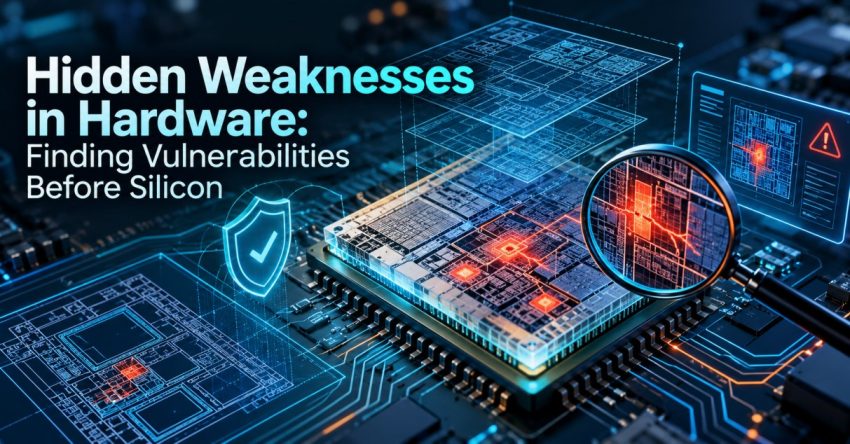
Hidden Weaknesses in Hardware: Finding Vulnerabilities Before Silicon

Posted on October 21, 2026 by Trident Techlabs Limited

The working of modern electronic devices requires elaborate hardware architectures. Vulnerabilities in hardware are not just limited to security issues of software but are also seen in applications like automobiles, communication, medical systems, and satellites. Thus, it becomes very essential to detect these flaws even before the device is manufactured, and this is an integral part of hardware security verification.

There are some vulnerabilities that can only be identified with unusual inputs or under abnormal conditions. Discovering them early can help engineering teams mitigate security risks and prevent crippling post-silicon engineering changes.

Why Hardware Vulnerabilities Are Difficult to Detect

A hardware design could be working in a normal way and then subsequently fail in an unusual manner if the combination of inputs it receives is unusual. This can result in the possibility of access to sensitive registers in an unforeseen manner, exposing confidential data and/or executing hidden functionality.

Simulation-based Testing – evaluates the chosen scenarios. Though mandatory, it will not always be adequate for all combinations of inputs/sequences, especially in large RTL circuits.

This poses a problem for hardware security testing, because engineers don’t know how to find weaknesses that aren’t captured in normal testing.

Formal Verification in Hardware Security

Formal verification involves mathematical techniques to study the behavior of hardware in relation to specified properties and requirements. It does not just test a limited number of scenarios, but systematically tries a much wider variety of scenarios.

This practice enables engineers to detect unforeseen behavior, possible information leakage and uncommon trigger states prior to product manufacture.

Early detection becomes even more useful when it comes to correcting hardware vulnerabilities after they have been fabricated, which could result in significant redesign costs, delays in production and further validation.

The use of CWE to identify design weaknesses

The Common Weakness Enumeration (CWE) is a structured classification of known weaknesses in software, firmware and hardware developed by MITRE. The CWE categories make it easier for engineers to identify and understand common vulnerability patterns in hardware designs.

Siemens EDA has solutions for various parts of hardware security. These are Questa Verify Secure for information-flow verification, and Questa Verify Trust for structural weaknesses and suspicious design behaviour detection.

Questa Verify Trust analyzes RTL designs and identifies patterns related to possible security issues, according to the CWE-based checks.

Examples include:

  • Unauthorized register access:Identifying design patterns that could potentially allow access to sensitive registers for unintended uses.
  • Information exposure:Detecting the signal paths that can possibly leak protected information.
  • Unexpected control behaviour:Indicating control logic that can behave in an unexpected way with unusual combinations of input.

This information can be used to explore possible weak points and understand that the design is working as expected.

Detecting Rare Triggers Before Chip Manufacturing

There may be some weaknesses or vulnerabilities in the hardware that don’t manifest until a very particular sequence of inputs is provided. This behaviour may be similar to a behaviour of a hardware Trojan in which the hidden or malicious function is activated only under specific circumstances.

Questa Verify Trust can be used to detect suspicious RTL structures and explore uncommon trigger conditions that are not addressed by traditional testing. When detected before fabrication, these problems enable design teams to discuss the logic, make revisions and validate the revised design.

Simulation, testing and other verification activities should not be a replacement for hardware security analysis, but should be used in conjunction with it.

Creating Hardware that is Trustworthy by Design

Building secure hardware is a process that needs to be addressed at all stages of the design process, and not only at the end before the product is tested. Formal verification in conjunction with CWE-based vulnerability analysis can help engineers to systematically explore potential vulnerabilities and help build confidence in their design.

Engineering teams can detect suspicious design patterns earlier with solutions like Questa Verify Trust and minimize exposure to designers’ hardware vulnerabilities and enable more secure electronic products.

Finally, the identification of the hidden weak points prior to manufacture of silicon makes hardware security a design consideration, not a post-manufacture issue.

Also Read: From Component Failure Rates to System Reliability: Connecting Reliability Prediction and RBD

Leave a Reply Cancel reply

Your email address will not be published. Required fields are marked *

Send Query

    Recent Posts

    • Hidden Weaknesses in Hardware: Finding Vulnerabilities Before Silicon
    • From Component Failure Rates to System Reliability: Connecting Reliability Prediction and RBD
    • Electronic Products Manufacture Company: From PCB Design to Product Validation
    • Shift-Left Verification for Software and Firmware Bring-Up: Validating Real-World Use Cases in a Pre-Silicon Environment
    • Closing the Silicon Verification Gap: How Formal Verification, Dynamic Simulation and AI Agents Can Work Together to Accelerate Tapeout

    Recent Comments

    1. Hidden Weaknesses in Hardware: Finding Vulnerabilities Before Silicon on From Component Failure Rates to System Reliability: Connecting Reliability Prediction and RBD
    2. From Component Failure Rates to System Reliability: Connecting Reliability Prediction and RBD on Electronic Products Manufacture Company: From PCB Design to Product Validation
    3. Electronic Products Manufacture Company: From PCB Design to Product Validation on Shift-Left Verification for Software and Firmware Bring-Up: Validating Real-World Use Cases in a Pre-Silicon Environment
    4. Electronic Products Manufacture Company: From PCB Design to Product Validation on How to Choose Right Electronic Products Manufacturing Company?
    5. Shift-Left Verification for Software and Firmware Bring-Up: Validating Real-World Use Cases in a Pre-Silicon Environment - Tridenttechlabsblogs - Trident on Closing the Silicon Verification Gap: How Formal Verification, Dynamic Simulation and AI Agents Can Work Together to Accelerate Tapeout

    Archives

    • October 2026
    • September 2026
    • August 2026
    • July 2026
    • June 2026
    • May 2026
    • April 2026
    • March 2026
    • February 2026
    • January 2026
    • December 2025
    • November 2025
    • October 2025
    • September 2025
    • August 2025
    • July 2025
    • June 2025
    • May 2025
    • April 2025
    • March 2025
    • February 2025
    • January 2025
    • December 2024
    • November 2024
    • October 2024
    • September 2024
    • August 2024
    • July 2024
    • June 2024
    • May 2024
    • April 2024
    • March 2024
    • February 2024
    • January 2024
    • December 2023
    • November 2023
    • October 2023
    • September 2023
    • August 2023

    Categories

    • ARC Flash
    • Arc Flash Risk Assessment
    • ASIC Design and Implementation
    • CAE
    • CAM
    • Cybersecurity
    • Electric Arc
    • Electronics Engineering
    • FPGA Design and Validation
    • Mechanical Engineering
    • PCB Design
    • Power Integrity
    • Reliability Analysis
    • Reliability and Quality Solutions
    • Safety Assessment
    • Semiconductor Solutions
    • Signal Integrity
    • software provider
    • Structural Analysis
    • Thermal Design

    Our Certificates

    • CMMI Level 3
    • Information Security Management System (ISO 27001:2022)
    • Quality Management System (ISO 9001:2015)
    • Information Technology Service Management (ISO/IEC 20000-1:2018)
    • Occupational Health & Safety Management System (ISO 45001:2018)

    Our Services

    • Engineering Solutions
    • Power System Solutions
    • Cybersecurity Solutions
    • Semiconductor Services

    Quick Links

    • Home
    • Company Overview
    • Investor Charter
    • Events
    • Blogs
    • Contact Us
    • Privacy Policy

    Trident Techlabs Limited

    • White House, 1/18-20, 2nd Floor, Rani Jhansi Road, New Delhi - 110055
    • +91-11-61811100
    • corporate@tridenttechlabs.com

    © All Copyright 2026 by Trident Techlabs

    imunify-bot-check