

Skip to content
Company Logo
  • Home
    • Trident Techlabs Limited (India)
    • Trident Techlabs LLC FZ (UAE)
    • Techlabs Semiconductor Pvt. Ltd. (Subsidiary)
  • About Us
    • Company Overview
    • Executive Leadership
  • Solutions
    Engineering Solutions
    Power System Solutions
    Cyber Security Services & Solution
    Techlabs Semiconductor
    style="width: 100%; height: 100%; object-fit: cover;">
    Academics
    style="width: 100%; height: 100%; object-fit: cover;">
    CAE
    style="width: 100%; height: 100%; object-fit: cover;">
    EDA
    style="width: 100%; height: 100%; object-fit: cover;">
    Products
    style="width: 100%; height: 100%; object-fit: cover;">
    Services
    style="width: 100%; height: 100%; object-fit: cover;">
    style="width: 100%; height: 100%; object-fit: cover;">
    style="width: 100%; height: 100%; object-fit: cover;">
  • Investor Charter
  • Events
    • Upcoming Events
    • Past Events
  • Careers
    • About Our Work
    • Job Listings
  • Resources
    • Webinars
    • Case Study
    • Brochure
    • Blog
  • Contact
Call Anytime +91-11-61811100
  • Home
    • Trident Techlabs Limited (India)
    • Trident Techlabs LLC FZ (UAE)
    • Techlabs Semiconductor Pvt. Ltd. (Subsidiary)
  • About Us
    • Company Overview
    • Executive Leadership
  • Solutions
    • Engineering Solutions
      • Engineering Solution
      • Academics
      • CAE
      • EDA
    • Power System Solutions
      • Products and Design Tools
      • Consulting Services
    • Cyber Security Services & Solutions
    • Techlabs Semiconductor
  • Investor Charter
  • Events
    • Upcoming Events
    • Past Events
  • Careers
    • About Our Work
    • Job Listings
  • Blog
  • Contact
PCB Manufacturing Companies in India

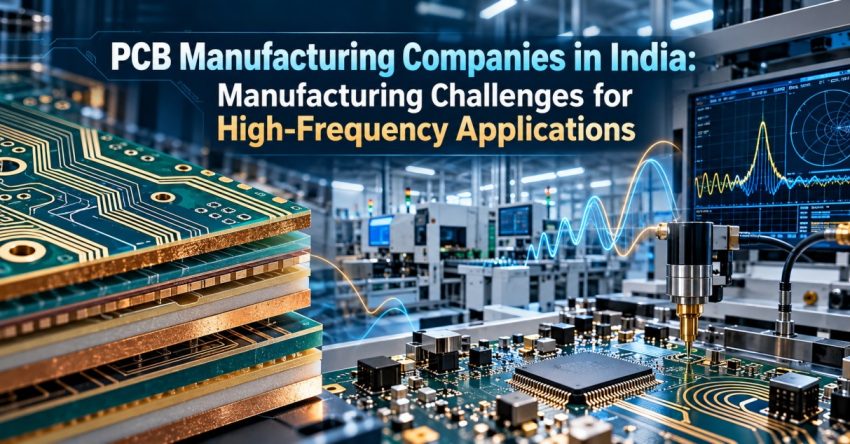
PCB Manufacturing Companies in India: Manufacturing Challenges for High-Frequency Applications

Posted on September 26, 2026 by Trident Techlabs Limited

Printed circuit boards have to meet requirements that exceed traditional manufacturing requirements for use in high frequency electronic systems. For telecommunications, radar, satellite systems, wireless communications, auto sensing and advanced test equipment, frequencies provide a space where slight differences in materials, size or manufacturing may be the difference between the required signal performance and failure. Therefore, when choosing PCB manufacturing companies in India, it is crucial to take into account the level of precision in manufacturing.

Selection of Material and Signal Performance

This is because the dielectric characteristics of the PCB material can have a significant impact on signal propagation at high frequencies. Typical parts may not have the electrical properties needed for severe RF/Microwave applications. The manufacturer may require special laminates with a regulated dielectric constant, low dissipation factor and uniform performance throughout the operating frequency range.

The thickness of the material and the properties of the copper are also important and should be controlled as they can affect impedance and transmission characteristics.

Controlled Impedance Requirements

Manufacturing is one of the most important factors to consider for high frequency PCBs and is known as controlled impedance. Signal traces must have proper impedance in order to avoid reflection.

This will need good collaboration between PCB design and fabrication. Impedance is related to trace width, copper thickness, and the thickness and properties of the dielectric material. Careful control of manufacturing tolerances is required, especially with multilayer boards with intricate stack-up structures.

Surface Finish and the Quality of the Copper

In high frequency applications, the quality and uniformity of the layers of copper may be more significant. At high frequencies surface roughness can cause signal loss due to currents running near the conductor surface.

Hence, there is need for proper deposition, etching, surface finishing process of copper for the manufacture of PCB for such applications in India. When PCBs are being produced on a large scale, it is also crucial to maintain consistency between production batches.

Multilayer Registration Challenges

Multilayer designs are often used in applications that require high-frequency designs for dense routing and to keep electromagnetic interference to a minimum. The more layers there are, the more difficult it is to accomplish accurate layer-to-layer registration.

Positional differences can impact differential pairs, controlled impedance traces, vias and other critical features. Thus, proper alignment during the lamination and drilling process is critical to ensure that the desired electrical properties of the product are achieved.

Thermal Management

High frequency electronics are capable of producing a lot of heat, especially when used with a high powered electronics. So it is necessary that the PCB offer an efficient thermal path, without compromising electrical properties that are essential to the design.

Manufacturing factors can be copper weight, thermal vias, substrate selection and board construction. These factors must be considered together, rather than as a separate production problem, called ‘thermal management’.

Test and Quality Control

The testing is particularly important if the PCBs are produced for high-frequency use. Problems with signal integrity or impedance cannot always be seen visually.

Depending on the needs of the board, manufacturers can employ electrical testing, impedance checking, dimensional checking and other process checks. Documenting manufacturing parameters will also enable the detection of variation between batches and maintain consistent manufacturing.

Selecting the right Manufacturing Partner

However, for engineering teams, the assessment of PCB Manufacturing Companies in India should not just be based on their production capacity and quoted prices. From their experience with high-frequency materials, controlled impedance, multilayer fabrication, precision drilling, surface finishes and quality-control processes, these can all affect the final board.

As electronic systems shrink, grow faster and become ever more interconnected, the production of PCBs must also be able to match the ever demanding electrical requirements. If you have a complex, high frequency design, manufacturers that have the necessary technical expertise and process discipline can assist you in creating a reliable design for production.

Frequently Asked Questions

What makes high-frequency PCB manufacturing different from standard PCB manufacturing?

High-frequency PCBs require tighter control over materials, impedance, copper quality, dimensions, and manufacturing tolerances.

Why is controlled impedance important in high-frequency PCBs?

Controlled impedance helps reduce signal reflections and supports reliable signal transmission at higher frequencies.

Which materials are commonly considered for high-frequency PCBs?

High-frequency designs usually require materials with a stable dielectric constant, low signal loss, and consistent electrical performance.

How does copper roughness affect high-frequency PCB performance?

Excessive copper surface roughness can increase signal loss and negatively affect high-frequency transmission.

Why is multilayer registration important in PCB manufacturing?

Accurate layer alignment helps maintain the performance of differential pairs, vias, impedance traces, and other critical features.

What causes signal loss in high-frequency PCBs?

Signal loss can result from unsuitable materials, copper roughness, impedance mismatch, manufacturing variations, and poor trace design.

How is impedance controlled during PCB manufacturing?

Impedance is controlled by managing trace width, copper thickness, dielectric thickness, material properties, and fabrication tolerances.

Why is thermal management important in high-frequency PCBs?

Good thermal management helps control heat while maintaining the electrical performance required by the PCB design.

What testing is needed for high-frequency PCBs?

Electrical testing, impedance checks, dimensional inspection, and process verification can help confirm PCB quality and consistency.

Can PCB manufacturing variations affect RF performance?

Yes, small variations in materials, dimensions, copper, or layer alignment can affect RF and microwave signal performance.

Why are special laminates used in high-frequency PCB designs?

Special laminates provide more stable dielectric properties and lower signal loss across high operating frequencies.

What should engineers check before selecting a PCB manufacturing company?

They should review experience with high-frequency materials, controlled impedance, multilayer fabrication, precision drilling, and quality control.

How do vias affect high-frequency PCB performance?

Poorly designed or misaligned vias can introduce impedance changes, signal loss, and unwanted electrical effects.

Why is batch consistency important in PCB manufacturing?

Consistent manufacturing helps ensure that electrical and mechanical performance remains similar across different production batches.

What are the main challenges in manufacturing high-frequency PCBs?

The main challenges include material control, impedance accuracy, copper quality, layer registration, thermal management, and reliable testing.

Also Read: Arc Flash Risk Reduction: Engineering Controls That Can Lower Exposure

Leave a Reply Cancel reply

Your email address will not be published. Required fields are marked *

Send Query

    Recent Posts

    • PCB Manufacturing Companies in India: Manufacturing Challenges for High-Frequency Applications
    • Arc Flash Risk Reduction: Engineering Controls That Can Lower Exposure
    • The Role of Power, Performance and Area in Custom ASIC Design Services
    • Engineering the Shield: How Vendor-Neutral Integration Eradicates Technical Debt in Defense SOCs
    • The Art of Cyber Deception: Turning the Tables on Lateral Movement in Enterprise Networks

    Recent Comments

    1. PCB Manufacturing Companies in India: Manufacturing Challenges for High-Frequency Applications on Pioneering Progress: PCB Manufacturing Companies In India
    2. Arc Flash Risk Reduction: Engineering Controls That Can Lower Exposure on The Role of Power, Performance and Area in Custom ASIC Design Services
    3. Arc Flash Risk Reduction: Engineering Controls That Can Lower Exposure on Understanding Arc Flash Assessment For Industrial Safety
    4. The Role of Power, Performance and Area in Custom ASIC Design Services on Engineering the Shield: How Vendor-Neutral Integration Eradicates Technical Debt in Defense SOCs
    5. Engineering the Shield: How Vendor-Neutral Integration Eradicates Technical Debt in Defense SOCs on The Art of Cyber Deception: Turning the Tables on Lateral Movement in Enterprise Networks

    Archives

    • September 2026
    • August 2026
    • July 2026
    • June 2026
    • May 2026
    • April 2026
    • March 2026
    • February 2026
    • January 2026
    • December 2025
    • November 2025
    • October 2025
    • September 2025
    • August 2025
    • July 2025
    • June 2025
    • May 2025
    • April 2025
    • March 2025
    • February 2025
    • January 2025
    • December 2024
    • November 2024
    • October 2024
    • September 2024
    • August 2024
    • July 2024
    • June 2024
    • May 2024
    • April 2024
    • March 2024
    • February 2024
    • January 2024
    • December 2023
    • November 2023
    • October 2023
    • September 2023
    • August 2023

    Categories

    • ARC Flash
    • Arc Flash Risk Assessment
    • ASIC Design and Implementation
    • CAE
    • CAM
    • Cybersecurity
    • Electric Arc
    • Electronics Engineering
    • FPGA Design and Validation
    • Mechanical Engineering
    • PCB Design
    • Power Integrity
    • Reliability Analysis
    • Safety Assessment
    • Semiconductor Solutions
    • Signal Integrity
    • software provider
    • Structural Analysis
    • Thermal Design

    Our Certificates

    • CMMI Level 3
    • Information Security Management System (ISO 27001:2022)
    • Quality Management System (ISO 9001:2015)
    • Information Technology Service Management (ISO/IEC 20000-1:2018)
    • Occupational Health & Safety Management System (ISO 45001:2018)

    Our Services

    • Engineering Solutions
    • Power System Solutions
    • Cybersecurity Solutions
    • Semiconductor Services

    Quick Links

    • Home
    • Company Overview
    • Investor Charter
    • Events
    • Blogs
    • Contact Us
    • Privacy Policy

    Trident Techlabs Limited

    • White House, 1/18-20, 2nd Floor, Rani Jhansi Road, New Delhi - 110055
    • +91-11-61811100
    • corporate@tridenttechlabs.com

    © All Copyright 2026 by Trident Techlabs

    imunify-bot-check