

Skip to content
Company Logo
  • Home
    • Trident Techlabs Limited (India)
    • Trident Techlabs LLC FZ (UAE)
    • Techlabs Semiconductor Pvt. Ltd. (Subsidiary)
  • About Us
    • Company Overview
    • Executive Leadership
  • Solutions
    Engineering Solutions
    Power System Solutions
    Cyber Security Services & Solution
    Techlabs Semiconductor
    style="width: 100%; height: 100%; object-fit: cover;">
    Academics
    style="width: 100%; height: 100%; object-fit: cover;">
    CAE
    style="width: 100%; height: 100%; object-fit: cover;">
    EDA
    style="width: 100%; height: 100%; object-fit: cover;">
    Products
    style="width: 100%; height: 100%; object-fit: cover;">
    Services
    style="width: 100%; height: 100%; object-fit: cover;">
    style="width: 100%; height: 100%; object-fit: cover;">
    style="width: 100%; height: 100%; object-fit: cover;">
  • Investor Charter
  • Events
    • Upcoming Events
    • Past Events
  • Careers
    • About Our Work
    • Job Listings
  • Resources
    • Webinars
    • Case Study
    • Brochure
    • Blog
  • Contact
Call Anytime +91-11-61811100
  • Home
    • Trident Techlabs Limited (India)
    • Trident Techlabs LLC FZ (UAE)
    • Techlabs Semiconductor Pvt. Ltd. (Subsidiary)
  • About Us
    • Company Overview
    • Executive Leadership
  • Solutions
    • Engineering Solutions
      • Engineering Solution
      • Academics
      • CAE
      • EDA
    • Power System Solutions
      • Products and Design Tools
      • Consulting Services
    • Cyber Security Services & Solutions
    • Techlabs Semiconductor
  • Investor Charter
  • Events
    • Upcoming Events
    • Past Events
  • Careers
    • About Our Work
    • Job Listings
  • Blog
  • Contact
Thermal Analysis Software

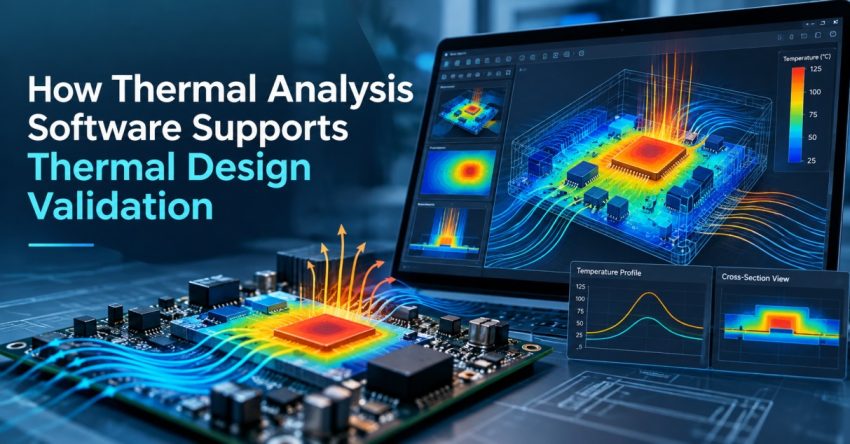
How Thermal Analysis Software Supports Thermal Design Validation

Posted on September 27, 2026September 29, 2026 by Trident Techlabs Limited

The thermal performance may affect reliability, efficiency and service life of engineered products. Excessive high temperature exposure may cause accelerated ageing, material deterioration or performance variations in components. Therefore, thermal validation should start as early as possible before a product undergoes physical testing. Thermal analysis software allows engineers to model the heat behaviour, test for design conditions and detect potential thermal problems in their design process.

Evaluating Temperature Distribution

A key application for thermal analysis software is to gain an understanding of the temperature distribution throughout a component or system. Heat generation, heat conduction, heat convection and heat radiation can be modeled by engineers to find how the thermal energy flows through the design.

This temperature distribution can help identify regions of hot or cold spots. If they are identified at the design phase, then the engineers can explore the possibilities of changing something before testing physical prototypes.

Identifying Thermal Hotspots

Even if the system temperature seems to be acceptable, localized hot spots can cause big reliability issues. The engineer can use simulation to look at the differences in temperature at certain parts of a design, at certain points between parts of a design, or at certain areas within a design.

In one instance, the critical parts of an electronic assembly can be located in close proximity to components that generate heat. Thermal analysis software can be used to determine if the proposed arrangement results in unacceptable temperature gradients, and if changes in component placement, or cooling are required.

An investigation of different operating conditions

Products are not usually tested at a single thermal condition. Thermal behaviour may be influenced by ambient temperature, workload, flow of power, airflow and surrounding components.

Using thermal analysis software, engineers can evaluate designs for various boundary conditions and operating scenarios. Multiple simulations can be done to make sure the design stays within the defined temperature limits under normal, demanding and abnormal conditions.

Comparing Cooling Strategies

Another aspect of thermal design validation is the ability of the system to reject heat generated. Simulation can help engineers evaluate various cooling options prior to their physical realization.

Possible design changes include heat sinks, heat interfaces, air flow paths, fans, vents, and/or changes in material selection. The simulated results can then be compared and analyzed to gain knowledge on the changes that are required to give the designer a meaningful thermal improvement and the changes that can be made to the overall design.

Supporting Design Iterations

While physical prototypes are useful for validation, creating and testing a number of prototypes can become time consuming and expensive. In addition to the initial design phase, simulation is an additional stage of testing that occurs before physical testing.

Engineers can change the geometry, materials, and locations of components and cooling systems and simulate again to test the impact of the changes. This cycle of design, build, test and redesign can pinpoint design drawbacks at an early stage and give more understanding of how a specific combination is performing.

Improving Validation Before Physical Testing

Physical validation is not a replacement for thermal simulation. Instead, it enables engineers to test the physical system with a more comprehensive design. From the simulation results, attention can be directed to areas that are critical and need more focus during the prototype testing phase.

If the results from simulation and testing are compared, this may also provide a way for engineers to improve the properties of materials, boundary conditions or modelling assumptions. This forms a loop which can enhance the accuracy of later analyses.

Supporting More Reliable Design Decisions

Thermal design validation needs to be more than just meeting a set temperature. Engineers should be able to understand how heat is distributed, thermal gradient, hotspot and performance under various operating conditions.

Thermal analysis software can aid this process by offering a means of analyzing these factors prior to production. Combining engineering judgement and physical testing with thermal simulation can enable teams to uncover potential risks at an earlier stage and to assess design options and create products that offer increasingly predictable thermal performance.

Frequently Asked Questions

What is thermal analysis software used for?

Thermal analysis software helps engineers study heat flow, temperature distribution, hotspots, and cooling performance before physical testing.

How does thermal analysis software help in design validation?

It allows engineers to test thermal behaviour under different conditions and identify potential design problems before prototype development.

Can thermal analysis software detect hotspots?

Yes, it can identify localized hotspots that may affect component reliability, performance, or service life.

Why is temperature distribution important in thermal design?

Temperature distribution shows how heat moves through a system and helps engineers identify areas that may overheat or remain too cold.

Can thermal simulation test different operating conditions?

Yes, engineers can simulate variations in ambient temperature, workload, airflow, power flow, and other operating conditions.

How does thermal analysis software improve cooling design?

It helps compare cooling options such as heat sinks, fans, vents, airflow paths, thermal interfaces, and material changes.

Does thermal analysis software replace physical testing?

No, thermal simulation supports physical testing by helping engineers identify critical areas that require closer prototype validation.

Can thermal simulation reduce prototype development time?

Yes, engineers can test multiple design changes virtually before creating physical prototypes, reducing unnecessary design iterations.

What design changes can be tested using thermal analysis software?

Engineers can evaluate changes in geometry, materials, component placement, airflow, and cooling system configurations.

How does thermal analysis improve product reliability?

It helps identify thermal risks early and supports design decisions that can improve predictable thermal performance and reliability.

Also Read: PCB Manufacturing Companies in India: Manufacturing Challenges for High-Frequency Applications

1 thought on “How Thermal Analysis Software Supports Thermal Design Validation”

  1. Pingback: PCB Design Services Near Me: How Engineers Manage Signal Integrity in Complex Boards

Leave a Reply Cancel reply

Your email address will not be published. Required fields are marked *

Send Query

    Recent Posts

    • PCB Design Services Near Me: How Engineers Manage Signal Integrity in Complex Boards
    • How Thermal Analysis Software Supports Thermal Design Validation
    • PCB Manufacturing Companies in India: Manufacturing Challenges for High-Frequency Applications
    • Arc Flash Risk Reduction: Engineering Controls That Can Lower Exposure
    • The Role of Power, Performance and Area in Custom ASIC Design Services

    Recent Comments

    1. PCB Design Services Near Me: How Engineers Manage Signal Integrity in Complex Boards on How Thermal Analysis Software Supports Thermal Design Validation
    2. How Thermal Analysis Software Supports Thermal Design Validation on PCB Manufacturing Companies in India: Manufacturing Challenges for High-Frequency Applications
    3. How Thermal Analysis Software Supports Thermal Design Validation on Understanding Thermal analysis software
    4. PCB Manufacturing Companies in India: Manufacturing Challenges for High-Frequency Applications on Pioneering Progress: PCB Manufacturing Companies In India
    5. Arc Flash Risk Reduction: Engineering Controls That Can Lower Exposure on The Role of Power, Performance and Area in Custom ASIC Design Services

    Archives

    • September 2026
    • August 2026
    • July 2026
    • June 2026
    • May 2026
    • April 2026
    • March 2026
    • February 2026
    • January 2026
    • December 2025
    • November 2025
    • October 2025
    • September 2025
    • August 2025
    • July 2025
    • June 2025
    • May 2025
    • April 2025
    • March 2025
    • February 2025
    • January 2025
    • December 2024
    • November 2024
    • October 2024
    • September 2024
    • August 2024
    • July 2024
    • June 2024
    • May 2024
    • April 2024
    • March 2024
    • February 2024
    • January 2024
    • December 2023
    • November 2023
    • October 2023
    • September 2023
    • August 2023

    Categories

    • ARC Flash
    • Arc Flash Risk Assessment
    • ASIC Design and Implementation
    • CAE
    • CAM
    • Cybersecurity
    • Electric Arc
    • Electronics Engineering
    • FPGA Design and Validation
    • Mechanical Engineering
    • PCB Design
    • Power Integrity
    • Reliability Analysis
    • Safety Assessment
    • Semiconductor Solutions
    • Signal Integrity
    • software provider
    • Structural Analysis
    • Thermal Design

    Our Certificates

    • CMMI Level 3
    • Information Security Management System (ISO 27001:2022)
    • Quality Management System (ISO 9001:2015)
    • Information Technology Service Management (ISO/IEC 20000-1:2018)
    • Occupational Health & Safety Management System (ISO 45001:2018)

    Our Services

    • Engineering Solutions
    • Power System Solutions
    • Cybersecurity Solutions
    • Semiconductor Services

    Quick Links

    • Home
    • Company Overview
    • Investor Charter
    • Events
    • Blogs
    • Contact Us
    • Privacy Policy

    Trident Techlabs Limited

    • White House, 1/18-20, 2nd Floor, Rani Jhansi Road, New Delhi - 110055
    • +91-11-61811100
    • corporate@tridenttechlabs.com

    © All Copyright 2026 by Trident Techlabs

    imunify-bot-check