
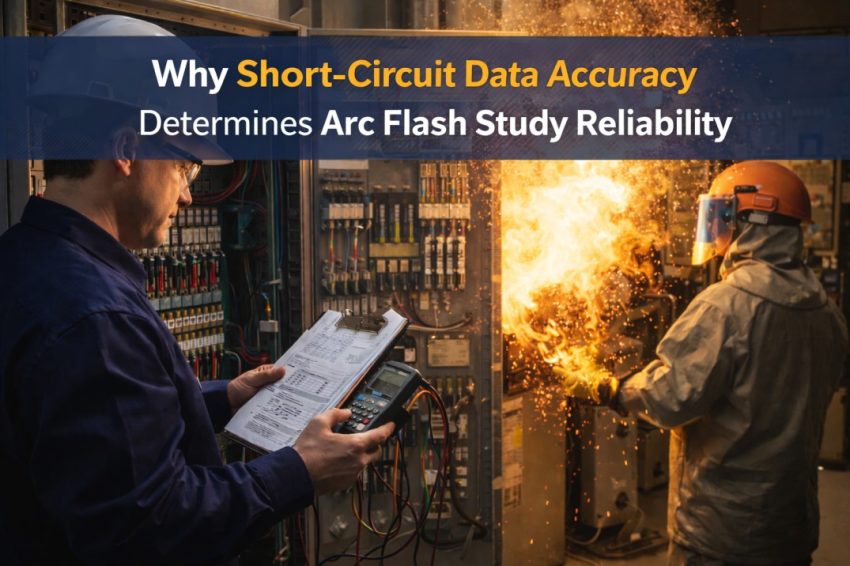
The risk of arc flash is directly proportional to the fault current availed in an electrical system. When the data of short-circuit considered in the analysis is faulty, the ultimate results will be inaccurate. It may result in the use of incorrect safety labels, PPE suggestions, and unsafe working conditions. Accurate arc flash study relies much on the accurate short-circuit data as it provides the basis of all incident energy computations.
What Short-Circuit Data Represents
Short-circuit data characterizes the highest fault current that may pass in case an electrical fault occurs. It relies on the strength of utility supply, ratings of transformers, cable impedance and contribution by the motor and system setup. The slightest mistakes in these values can cause the levels of calculated fault to vary greatly.
This data is used in the arc flash study to calculate the amount of energy that would be emitted during an arc fault. In case of incorrect initial data, the whole analysis will be false.
How Fault Current Influences Arc Flash Energy
The fault current magnitude and clearing time of the protective device determines the incident energy during an arc flash. A large fault current may cause arc energy to rise, although in certain circumstances they may make protective devices to trip more quickly and shorten exposure time. Due to such a complicated connection, precise data is necessary.
The arc flash study should strike a balance on these points. Wrong short-circuit values may lead to underestimation of hazards or overestimation of hazards, both of which have safety and operational issues.
Common Sources of Data Errors
Most facilities use outdated drawings or generic equipment values in making an analysis. Modifications like cable replacements, transformer modifications or extra motors are usually not documented. Updates of the utility fault level are also often neglected.
Failure to capture such updates will not give accurate arc flash study given the true conditions of the system. Field verification and data validation are thus very important in the process of ensuring reliability.
Impact on Safety Labels and PPE Selection
Arc flash labels instruct workers about the necessary PPE and safe working distance. When the information about short-circuit is not correct, the labels can be below or above the hazard levels. Underestimation will predispose workers to severe harm whereas overestimation will render maintenance to be needlessly sophisticated and costly.
Using a reliable arc flash study would mean that PPE requirements are set to be in line with the actual risk levels which means better safety and efficiency.
Effect on Protection Device Performance
Breakers and relays are protection devices that are made to act according to the fault current levels. When the arc flash study takes the wrong short-circuit data, it might assume that the protection devices will be able to trip sooner or later as compared to how they will in the real world.
This has a direct impact on incident energy work. The proper short-circuit modeling is the first step in the arc flash study to make sure that the protection behavior is modeled accurately.
System Changes and Utility Variations
Electrical systems rarely remain static. Fault current can be altered by load additions, distributed generation, and renewable energy sources. Another way is that utilities can upgrade their supply networks, adding fault current at the point of connection to the facility.
Frequent review of short-circuit data will make sure that the arc flash study is valid when the conditions change.
Moving from Assumptions to Measured Data
Studies that are founded on the field data that have been proven are the most trusted. This involves verification of cable lengths, values of transformer impendences and settings of protective devices. Confirmation of utility fault level is also important.
An arc flash study must be based on real measurements, which allows for the results that can be relied upon when planning safety in the long term.
Conclusion
The strength of a study on arc flash can only be as strong as the short-circuit data that was employed in its calculations. Poor data will result in poor hazard levels, incorrect choice of PPE, and poor protection assumptions. Proper short-circuit data guarantees that incident energy analysis is realistic system behavior.
By ensuring the accuracy of their data, organizations enhance the usefulness of their arc flash study and ensure safer working conditions of the electrical personnel.
Also Read: Applications of Fault Tree Analysis in Aerospace, Automotive, and Manufacturing Industries