


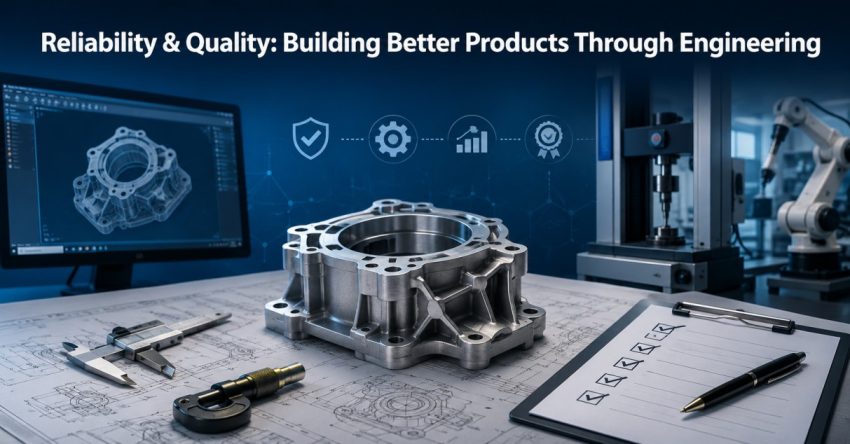
Reliability and quality are key to the success of product development. Functional requirements must be fulfilled at the time of product release but for long-term success, it is important that the product continues to meet this requirement under actual operating conditions. Reliability engineering offers a systematic approach to discovering potential failures, understanding how they affect the product and enhancing its performance during its life cycle. Designing reliability into products can minimize unexpected failures, enhance customer satisfaction and aid in the development of safer products, in both academic research and industrial development. Trident Techlabs offers reliability and quality engineering solutions which combine these principles in design, testing, development, and deployment.
Understanding RAMS in Product Development
RAMS is an acronym for Reliability, Availability, Maintainability and Safety. These four elements deliver a more holistic perspective of product and system performance.
Reliability is more about whether a product is going to do what it is supposed to do, and not fail. Availability is the ability of the product to be available when needed. Maintainability is about how quickly a failed or degraded system can be restored and Safety is about risk is managed to protect people, assets and the environment.
Engineers can reduce weaknesses as early as possible in the design process, preventing them from being costly issues in production or deployment by taking RAMS into account.
Outline key reliability engineering techniques that are employed in practice.
Reliability engineering employs various analytical and statistical techniques to analyze possible failures from various angles.
The FMEA process can be used to identify failure modes early.
Failure Mode and Effects Analysis (FMEA): This methodically looks at the potential for components or processes to fail and assesses the potential effects. It is useful for engineering teams to prioritize risks and take corrective measures before they will become problems for the customer.
FRACAS: learning from actual failures
Failure Reporting, Analysis, and Corrective Action System (FRACAS) provides a framework for documenting events, understanding root cause and initiating corrective actions, and monitoring progress towards resolution. Importantly, failure data from the field can be used for design and reliability analysis, thus closing the loop for continuous improvement.
The techniques of Fault Tree Analysis and RBD
Fault Tree Analysis (FTA) is a bottom-up method, which begins with an undesired event in the system and investigates possible combinations of failures that can result in the event.
Another view is offered by Reliability Block Diagrams (RBDs) that model the interactions between the various components of a system and how these interactions affect the reliability and availability of the system.
Reliability Prediction and RCM
Reliability prediction is based on the information available for the components and system, and is used to estimate the reliability performance expected for the system. Reliability-Centered Maintenance (RCM) complements this in a way of identifying the maintenance strategy for the system based on the consequences of failure, functions of the system and operational requirement.
Learn how to apply Statistical Analysis to understand Product Life
Reliability data can be used to determine the likelihood of failure and how the product will fail.
Examples of failure pattern and life data analysis include Weibull Analysis, and the measurement of the B-life and probability of failure for a given period. It can be useful to engineers in determining whether the failures are related to early-life problems, random events or wear-out behavior.
Accelerated Life Testing (ALT) is used to test the product under higher stresses and investigate life characteristics in a shorter time. Accelerated test results can then be correlated to the performance to be expected under normal operating conditions through the use of statistical models.
Reliability throughout the product lifecycle
Don’t think of reliability as a final testing step. It works best when applied at the concept and design stage and applied from development, manufacturing, deployment and field operations. Analysis at an early stage of design can detect design weaknesses and test and field data can be used for improvements as a result of the tests.
This lifecycle perspective also benefits academia and industry by bridging the gap between theory and engineering decisions related to reliability.
Trident Techlabs provides support to Reliability Engineering.
Through its partnership with Relyence, Trident Techlabs has formed a reliability and quality engineering program. The solution integrates FMEA, FRACAS, Fault Tree Analysis, Reliability Prediction, RBD, Weibull Analysis, Accelerated Life Testing and other processes related to reliability in a single environment. This can help promote consistency across engineering teams, minimize duplicate data handling and link design, test and quality activities together.
Conclusion
Reliability and quality are not just an assessment of product performance at the end of the line, but a result of the work the engineers have done in a controlled way throughout the product lifecycle. When designers use RAMS approaches in conjunction with FMEA, FRACAS, FTA, RBD, reliability prediction, RCM, Weibull Analysis and ALT, they can anticipate and identify risks at an earlier stage and make informed design decisions.
The ability to incorporate these techniques into the product development process can help improve the quality, reliability, and safety of products for academic institutions and industrial organisations. Organizations can trust in Trident Techlabs’ reliability and quality engineering solutions to implement structured reliability practices from design to deployment.