


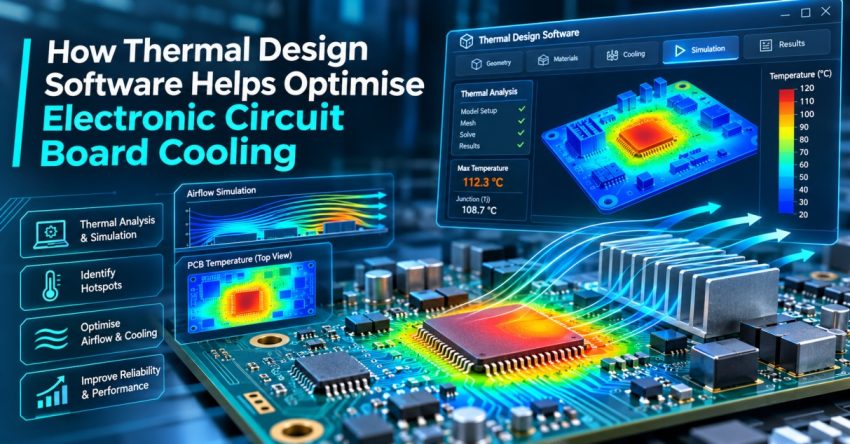
Electronic circuit boards are getting compact, while supporting more powerful components and higher operating speeds. The mix can create a lot of heat, especially in processors, power electronics and circuit assemblies with high density. When unmanaged, heat can impact the performance of the components, decrease reliability and shorten product life. Thermal design software enables engineers to analyse the distribution of heat, determine where hot spots might be in a product and assess how to cool the product before creating a physical prototype.
Identifying Hotspots Before Production
Printed circuit boards (PCBs) may not be evenly covered with heat. Some devices like voltage regulators, power transistors and processors can heat up more than other devices. If not analysed properly, these hotspots can only be identified at a physical test.
Engineers use thermal design software to simulate temperatures at various points of a circuit board under specific operating conditions. The results can show where temperatures might go outside the components’ limits, allowing the designer to deal with potential issues earlier in the design process.
These issues may be determined before manufacture, thus reducing the necessity for redesign and/or aiding in product development.
Component Placement and Board layout Improvement
Thermal characteristics heavily rely on components being mounted. If placed too close to one another, it can create hot spots; moreover, inappropriate distances can obstruct airflow, making it harder to dissipate the heat.
With thermal simulation, engineers have the possibility to experiment with different layouts and observe how the positioning of the components affects temperature distribution. They are also able to quantify the effect of copper areas, thermal vias and heat spreaders on heat transfer.
These insights are useful for engineers to compare design alternatives and choose layouts based on the thermal performance in combination with electrical, mechanical and space limitations.
Evaluating Cooling Methods through Simulation
There are different cooling methods for different electronic products. Passive cooling can be used for compact consumer devices, and heat sinks, fans or liquid cooling for high power systems.
Using thermal design software, engineers can make these comparisons against a set of conditions. Simulations can be used to test:
- Heat conduction in circuit boards and components.
- Air flow and convective heat around important elements.
- Changes in temperature under various load rates.
- The cooling capacity of heat sinks and other cooling structures.
This means that the design team can explore cooling needs without having to invest in expensive physical changes.
Minimizing Prototype Changes and Costs
Physical testing is still a critical part of the validation of thermal performance, but multiple changes to the prototype may raise costs and development time. When using simulation, engineers can spot potential trouble spots and can limit the choices of reasonable design options before constructing hardware.
Using a digital evaluation of several configurations, teams can prioritize designs to be tested physically. The accuracy of the simulation results relies heavily on accurate material properties, power inputs, boundary conditions and assumptions, therefore, simulation results should be checked against the test data when possible.
Supporting Reliable Electronic Product Design
Thermal management is an important consideration in automotive electronics, industrial control systems, telecommunications equipment and power conversion devices. These applications can be impacted by excessive temperatures, with performance and component life and system reliability being among the impacted areas.
Thermal design software assists engineers in making informed decisions on component placement, board construction and cooling needs. It helps to achieve a more systematic approach to electronic product development when used in conjunction with electrical analysis, design verification and physical testing.
Conclusion
The benefits of a cooling solution for circuit boards start at the design phase and not once the problem of overheating has arisen. Thermal design software provides an engineer with tools to study heat distribution, compare cooling methods and determine possible temperature problems prior to manufacturing. The use of thermal analysis early in the design process can help engineering teams to make better decisions, minimize unnecessary changes in designs, and create electronic products that achieve their desired performance and reliability.
Also Read: Why Equipment Upgrades Should Trigger a Fresh ARC Flash Assessment