

Skip to content
Company Logo
  • Home
    • Trident Techlabs Limited (India)
    • Trident Techlabs LLC FZ (UAE)
    • Techlabs Semiconductor Pvt. Ltd. (Subsidiary)
  • About Us
    • Company Overview
    • Executive Leadership
  • Solutions
    Engineering Solutions
    Power System Solutions
    Cyber Security Services & Solution
    Techlabs Semiconductor
    style="width: 100%; height: 100%; object-fit: cover;">
    Academics
    style="width: 100%; height: 100%; object-fit: cover;">
    CAE
    style="width: 100%; height: 100%; object-fit: cover;">
    EDA
    style="width: 100%; height: 100%; object-fit: cover;">
    Products
    style="width: 100%; height: 100%; object-fit: cover;">
    Services
    style="width: 100%; height: 100%; object-fit: cover;">
    style="width: 100%; height: 100%; object-fit: cover;">
    style="width: 100%; height: 100%; object-fit: cover;">
  • Investor Charter
  • Events
    • Upcoming Events
    • Past Events
  • Careers
    • About Our Work
    • Job Listings
  • Resources
    • Webinars
    • Case Study
    • Brochure
    • Blog
  • Contact
Call Anytime +91-11-61811100
  • Home
    • Trident Techlabs Limited (India)
    • Trident Techlabs LLC FZ (UAE)
    • Techlabs Semiconductor Pvt. Ltd. (Subsidiary)
  • About Us
    • Company Overview
    • Executive Leadership
  • Solutions
    • Engineering Solutions
      • Engineering Solution
      • Academics
      • CAE
      • EDA
    • Power System Solutions
      • Products and Design Tools
      • Consulting Services
    • Cyber Security Services & Solutions
    • Techlabs Semiconductor
  • Investor Charter
  • Events
    • Upcoming Events
    • Past Events
  • Careers
    • About Our Work
    • Job Listings
  • Blog
  • Contact
Thermal Design Software

How Thermal Design Software Helps Optimise Electronic Circuit Board Cooling

Posted on November 25, 2026November 27, 2026 by Trident Techlabs Limited

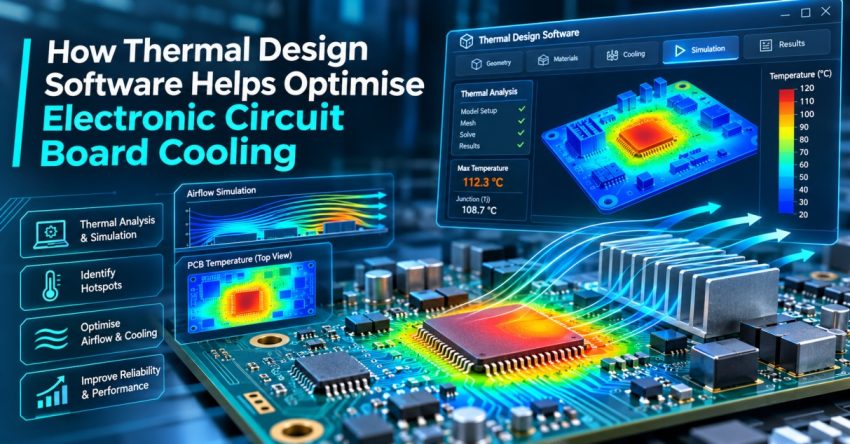
Electronic circuit boards are getting compact, while supporting more powerful components and higher operating speeds. The mix can create a lot of heat, especially in processors, power electronics and circuit assemblies with high density. When unmanaged, heat can impact the performance of the components, decrease reliability and shorten product life. Thermal design software enables engineers to analyse the distribution of heat, determine where hot spots might be in a product and assess how to cool the product before creating a physical prototype.

Identifying Hotspots Before Production

Printed circuit boards (PCBs) may not be evenly covered with heat. Some devices like voltage regulators, power transistors and processors can heat up more than other devices. If not analysed properly, these hotspots can only be identified at a physical test.

Engineers use thermal design software to simulate temperatures at various points of a circuit board under specific operating conditions. The results can show where temperatures might go outside the components’ limits, allowing the designer to deal with potential issues earlier in the design process.

These issues may be determined before manufacture, thus reducing the necessity for redesign and/or aiding in product development.

Component Placement and Board layout Improvement

Thermal characteristics heavily rely on components being mounted. If placed too close to one another, it can create hot spots; moreover, inappropriate distances can obstruct airflow, making it harder to dissipate the heat.

With thermal simulation, engineers have the possibility to experiment with different layouts and observe how the positioning of the components affects temperature distribution. They are also able to quantify the effect of copper areas, thermal vias and heat spreaders on heat transfer.

These insights are useful for engineers to compare design alternatives and choose layouts based on the thermal performance in combination with electrical, mechanical and space limitations.

Evaluating Cooling Methods through Simulation

There are different cooling methods for different electronic products. Passive cooling can be used for compact consumer devices, and heat sinks, fans or liquid cooling for high power systems.

Using thermal design software, engineers can make these comparisons against a set of conditions. Simulations can be used to test:

  • Heat conduction in circuit boards and components.
  • Air flow and convective heat around important elements.
  • Changes in temperature under various load rates.
  • The cooling capacity of heat sinks and other cooling structures.

This means that the design team can explore cooling needs without having to invest in expensive physical changes.

Minimizing Prototype Changes and Costs

Physical testing is still a critical part of the validation of thermal performance, but multiple changes to the prototype may raise costs and development time. When using simulation, engineers can spot potential trouble spots and can limit the choices of reasonable design options before constructing hardware.

Using a digital evaluation of several configurations, teams can prioritize designs to be tested physically. The accuracy of the simulation results relies heavily on accurate material properties, power inputs, boundary conditions and assumptions, therefore, simulation results should be checked against the test data when possible.

Supporting Reliable Electronic Product Design

Thermal management is an important consideration in automotive electronics, industrial control systems, telecommunications equipment and power conversion devices. These applications can be impacted by excessive temperatures, with performance and component life and system reliability being among the impacted areas.

Thermal design software assists engineers in making informed decisions on component placement, board construction and cooling needs. It helps to achieve a more systematic approach to electronic product development when used in conjunction with electrical analysis, design verification and physical testing.

Conclusion

The benefits of a cooling solution for circuit boards start at the design phase and not once the problem of overheating has arisen. Thermal design software provides an engineer with tools to study heat distribution, compare cooling methods and determine possible temperature problems prior to manufacturing. The use of thermal analysis early in the design process can help engineering teams to make better decisions, minimize unnecessary changes in designs, and create electronic products that achieve their desired performance and reliability.

Also Read: Why Equipment Upgrades Should Trigger a Fresh ARC Flash Assessment

Leave a Reply Cancel reply

Your email address will not be published. Required fields are marked *

Send Query

    Recent Posts

    • How Thermal Design Software Helps Optimise Electronic Circuit Board Cooling
    • Why Equipment Upgrades Should Trigger a Fresh ARC Flash Assessment
    • PCB Design: When “Perfectly Routed” Doesn’t Mean “Perfectly Working”
    • How CAM350 Helps Connect PCB Design and Manufacturing
    • Choosing the Right Solver in FEKO: MoM, MLFMM, FEM and High-Frequency Methods

    Recent Comments

    1. How Thermal Design Software Helps Optimise Electronic Circuit Board Cooling on Why Equipment Upgrades Should Trigger a Fresh ARC Flash Assessment
    2. How Thermal Design Software Helps Optimise Electronic Circuit Board Cooling on The Importance of Thermal Design Software In Modern Engineering
    3. ARC Flash assessmentsWhy Equipment Upgrades Should Trigger a Fresh ARC Flash Assessment on What Is Arc Flash Analysis and Why Is It Important for Electrical Safety?
    4. PCB Design: When “Perfectly Routed” Doesn’t Mean “Perfectly Working” on How CAM350 Helps Connect PCB Design and Manufacturing
    5. How CAM350 Helps Connect PCB Design and Manufacturing on Choosing the Right Solver in FEKO: MoM, MLFMM, FEM and High-Frequency Methods

    Archives

    • November 2026
    • October 2026
    • September 2026
    • August 2026
    • July 2026
    • June 2026
    • May 2026
    • April 2026
    • March 2026
    • February 2026
    • January 2026
    • December 2025
    • November 2025
    • October 2025
    • September 2025
    • August 2025
    • July 2025
    • June 2025
    • May 2025
    • April 2025
    • March 2025
    • February 2025
    • January 2025
    • December 2024
    • November 2024
    • October 2024
    • September 2024
    • August 2024
    • July 2024
    • June 2024
    • May 2024
    • April 2024
    • March 2024
    • February 2024
    • January 2024
    • December 2023
    • November 2023
    • October 2023
    • September 2023
    • August 2023

    Categories

    • ARC Flash
    • Arc Flash Risk Assessment
    • ASIC Design and Implementation
    • CAE
    • CAM
    • Cybersecurity
    • Electric Arc
    • Electronics Engineering
    • FPGA Design and Validation
    • Mechanical Engineering
    • PCB Design
    • Power Integrity
    • Reliability Analysis
    • Reliability and Quality Solutions
    • Safety Assessment
    • Semiconductor Solutions
    • Signal Integrity
    • software provider
    • Structural Analysis
    • Thermal Design

    Our Certificates

    • CMMI Level 3
    • Information Security Management System (ISO 27001:2022)
    • Quality Management System (ISO 9001:2015)
    • Information Technology Service Management (ISO/IEC 20000-1:2018)
    • Occupational Health & Safety Management System (ISO 45001:2018)

    Our Services

    • Engineering Solutions
    • Power System Solutions
    • Cybersecurity Solutions
    • Semiconductor Services

    Quick Links

    • Home
    • Company Overview
    • Investor Charter
    • Events
    • Blogs
    • Contact Us
    • Privacy Policy

    Trident Techlabs Limited

    • White House, 1/18-20, 2nd Floor, Rani Jhansi Road, New Delhi - 110055
    • +91-11-61811100
    • corporate@tridenttechlabs.com

    © All Copyright 2026 by Trident Techlabs