


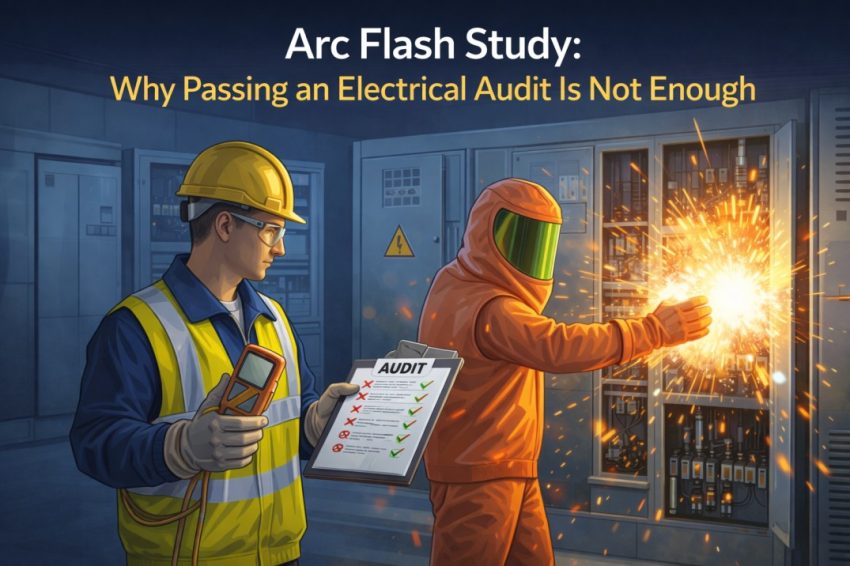
A large number of industrial and business premises are glad to know that they are passing electrical check-ups on a regular basis. Such audits have been regarded as evidence that the electrical system is safe, compliant and in good condition. Nevertheless, the successful completion of an audit does not necessarily imply that employees are immune to one of the most harmful electrical accidents, including arc flash accidents. It is in this area that an arc flash study is necessary in closing key safety deficiencies that are illuminated in an audit.
What is Covered by Electrical Audit
The major reason why an electrical audit is taken is to ensure that the systems used are in regard to the standards and regulations provided. It pays attention to observable issues like wiring integrity, earthing, labeling of panels, insulation resistance, and also adherence to load limits. Audits assist in detecting blatant malpractices and maintenance problems, however, they are mostly checklist compliant. They do not aim at a profound study of the behavior of an electric system in the presence of a fault, but rather to verify that it is performed correctly.
Consequently, several facilities fail audits despite never having evaluated the incident energy levels, fault clearance and the actual exposure risk that technicians take when working live.
The Hidden Risk That Audits Do Not Address
Arc flash accidents take place when electrical energy is suddenly discharged because of a fault. The heat, pressure and light that results may be devastatingly burning, equipment destroying and fatal. Electrical audits hardly ever estimate the amount of energy that would be emitted in the event of such a fault. They also fail to establish safe working distance and amount of personal protective equipment to be used with particular panels.
An arc flash study does not contain shallow inspection. It tests the electrical system in faulty conditions and determines the potentially dangerous nature of a real-life occurrence.
Why Passing an Audit Can Create False Confidence
Organizations might be misguided to think that their safety is being provided when they use audit reports as their sole guide. It is this misleading thinking that has in most cases resulted in technicians operating on live panels without protection or any proper risk perception. In most arc flash accidents reported, the facility was technically correct but without an up-to-date arc flash study.
Audits ensure that the rules are adhered to. A research establishes whether such rules help to save individuals in case of an electrical malfunction.
How an Arc Flash Study Complements Audits
More arc flash study investigates short-circuit level, coordination between protective devices and fault clearing time to compute incident energy. It recognizes where the energy levels are above the safe levels and suggests control procedures. They can consist of new types of PPE, warning signs, or switching the relay settings or even redesigning the system.
The arc flash study is concentrating on the exposure of the workers instead of the system condition, which is the case of audits. It takes the technical information and converts it into real-world safety advice to electricians and maintenance personnel.
Legal and Liability Implications
Audit certificates are not the end of the road to the investigation authorities, in case of an electrical accident. They look at the identification and mitigation of foreseeable risks. In case a facility failed audits though never performed an arc flash study, it can be regarded as negligent in particular when employees are exposed to the known arc flash dangers without any adequate evaluation.
The use of arc flash analysis as due diligence and not an option is increasingly being seen as a mandatory process by courts and insurers.
System Changes Make Audits Incomplete
Electrical systems develop with time. Fault levels are altered due to load additions, transformer upgrades, generator integration, and renewable sources of energy. An audit can check that the installations are tidy and working, but it will not reevaluate the impact of such changes on arc flash risk.
Such modifications can only be reflected on the worker safety in an updated arc flash study.
Conclusion
Electrical audit is significant but it does not have the last word about electrical safety. Conformance is ensured by audits and actual danger is assessed using an arc flash study. Institutions that are solely dependent on audits fail to notice important exposure risks that result in severe injuries and lawsuits.
An all-encompassing electrical safety plan views audits and arc flash study as complement—not alternative. Safety does not rest in the boxes, but knowledge and management of risks that employees have to deal with on a daily basis.
Also Read: The Best Structural Analysis Software Suitable for Different Industries