

Skip to content
Company Logo
  • Home
    • Trident Techlabs Limited (India)
    • Trident Techlabs LLC FZ (UAE)
    • Techlabs Semiconductor Pvt. Ltd. (Subsidiary)
  • About Us
    • Company Overview
    • Executive Leadership
  • Solutions
    Engineering Solutions
    Power System Solutions
    Cyber Security Services & Solution
    Techlabs Semiconductor
    style="width: 100%; height: 100%; object-fit: cover;">
    Academics
    style="width: 100%; height: 100%; object-fit: cover;">
    CAE
    style="width: 100%; height: 100%; object-fit: cover;">
    EDA
    style="width: 100%; height: 100%; object-fit: cover;">
    Products
    style="width: 100%; height: 100%; object-fit: cover;">
    Services
    style="width: 100%; height: 100%; object-fit: cover;">
    style="width: 100%; height: 100%; object-fit: cover;">
    style="width: 100%; height: 100%; object-fit: cover;">
  • Investor Charter
  • Events
    • Upcoming Events
    • Past Events
  • Careers
    • About Our Work
    • Job Listings
  • Resources
    • Webinars
    • Case Study
    • Brochure
    • Blog
  • Contact
Call Anytime +91-11-61811100
  • Home
    • Trident Techlabs Limited (India)
    • Trident Techlabs LLC FZ (UAE)
    • Techlabs Semiconductor Pvt. Ltd. (Subsidiary)
  • About Us
    • Company Overview
    • Executive Leadership
  • Solutions
    • Engineering Solutions
      • Engineering Solution
      • Academics
      • CAE
      • EDA
    • Power System Solutions
      • Products and Design Tools
      • Consulting Services
    • Cyber Security Services & Solutions
    • Techlabs Semiconductor
  • Investor Charter
  • Events
    • Upcoming Events
    • Past Events
  • Careers
    • About Our Work
    • Job Listings
  • Blog
  • Contact
The Art of Cyber Deception: Turning the Tables on Lateral Movement in Enterprise Networks

The Art of Cyber Deception: Turning the Tables on Lateral Movement in Enterprise Networks

Posted on September 8, 2026September 8, 2026 by Trident Techlabs Limited

The intrusion does not stop at the firewall; it starts there. If the hacker gets through the network perimeters or has managed to obtain a set of valid credentials, the next phase is much more difficult to detect: it is about silently roaming around the network, elevating privileges, and searching for the valuable resources within it. Lateral movement is what security technologies find the most challenging. They have been designed to detect the familiar signatures and anomalies, but if the intruder is patient enough to use his legitimate credentials, he will blend into the system unnoticed. Cyber deception uses the attacker’s skills against him.

The Building of the Digital Minefield

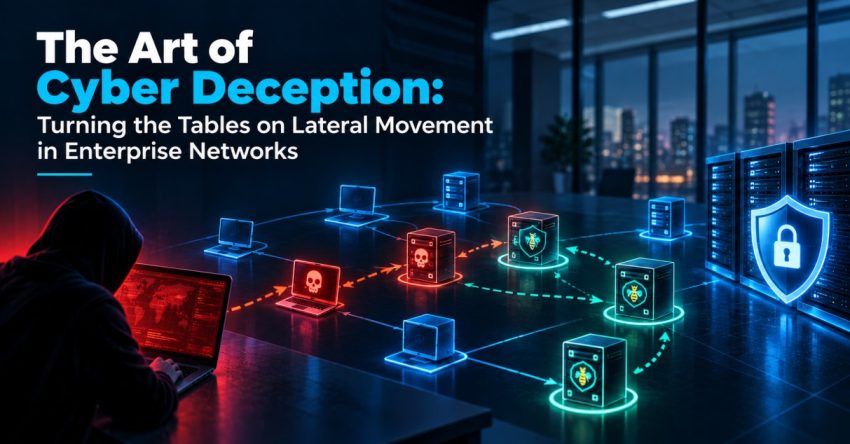
In essence, deception technology populates the network with realistic-looking decoys — false servers, phony databases, faked credentials, and simulated file shares.

To an attacker conducting reconnaissance, these decoys look exactly like real targets: familiar naming conventions, active services, believable value. The environment effectively becomes a digital minefield, except every “mine” stays completely silent to legitimate users, who have no operational reason to ever touch these planted assets.

Alerts You Can Actually Trust

This is what sets deception apart. Traditional detection sifts through oceans of legitimate activity searching for anomalies, generating a steady stream of alerts that need human triage. A touch on a decoy has no innocent explanation — no employee, script, or approved application should ever query a fake credential or connect to a decoy server. The moment it happens, the alert isn’t a probability buried in a SIEM queue; it’s a near-certain signal that someone unauthorized is already inside. Security teams get high-fidelity, actionable alerts instead of noise, often catching intrusions at the very first step of lateral movement — long before an attacker reaches anything that matters.

Changing the Attacker’s Calculus

Deception also reshapes the psychology of an intrusion. Attackers depend on exploring a network freely, testing credentials and mapping systems without consequence. When any unexplored corner could be a trap, that freedom disappears. Reconnaissance itself becomes risky, dwell time shrinks, and defenders gain something rare in cybersecurity: control of the terrain. Every interaction with a decoy also yields intelligence — the tools, paths, and techniques an attacker favors — that teams can use to harden real assets before the next attempt.

A Layer, Not a Replacement

Deception doesn’t replace firewalls, endpoint protection, or identity controls; it catches what those tools miss. As adversaries grow more patient and credential-savvy, this proactive layer is becoming less of an add-on and more of a core piece of resilient security architecture — one that assumes the perimeter will eventually be crossed and prepares accordingly.

Building that kind of layered, resilience-first defense takes the right architecture and expertise. Trident Techlabs’ cybersecurity team works with enterprises to design detection strategies fit for their infrastructure and risk profile — explore Trident Techlabs’ cybersecurity solutions to learn more.

Also Read: What the Data Leak in Banking Institution Teaches Organizations about Identity Security

Leave a Reply Cancel reply

Your email address will not be published. Required fields are marked *

Recent Posts

  • The Art of Cyber Deception: Turning the Tables on Lateral Movement in Enterprise Networks
  • What the Data Leak in Banking Institution Teaches Organizations about Identity Security
  • The Lifecycle of Resilience: How Proactive Managed Support Keeps Public Sector SOCs Ahead of the Threat Curve
  • Securing India’s Critical Infrastructure: Why PSUs Must Transition to UEBA-Powered Next-Gen SOCs
  • Structural Analysis Software Online for Faster Design Iterations

Recent Comments

  1. The Art of Cyber Deception: Turning the Tables on Lateral Movement in Enterprise Networks on What the Data Leak in Banking Institution Teaches Organizations about Identity Security

Archives

  • September 2026
  • August 2026
  • July 2026
  • June 2026
  • May 2026
  • April 2026
  • March 2026
  • February 2026
  • January 2026
  • December 2025
  • November 2025
  • October 2025
  • September 2025
  • August 2025
  • July 2025
  • June 2025
  • May 2025
  • April 2025
  • March 2025
  • February 2025
  • January 2025
  • December 2024
  • November 2024
  • October 2024
  • September 2024
  • August 2024
  • July 2024
  • June 2024
  • May 2024
  • April 2024
  • March 2024
  • February 2024
  • January 2024
  • December 2023
  • November 2023
  • October 2023
  • September 2023
  • August 2023

Categories

  • ARC Flash
  • Arc Flash Risk Assessment
  • ASIC Design and Implementation
  • CAE
  • CAM
  • Cybersecurity
  • Electric Arc
  • Electronics Engineering
  • FPGA Design and Validation
  • Mechanical Engineering
  • PCB Design
  • Power Integrity
  • Reliability Analysis
  • Safety Assessment
  • Semiconductor Solutions
  • Signal Integrity
  • software provider
  • Structural Analysis
  • Thermal Design

Our Certificates

  • CMMI Level 3
  • Information Security Management System (ISO 27001:2022)
  • Quality Management System (ISO 9001:2015)
  • Information Technology Service Management (ISO/IEC 20000-1:2018)
  • Occupational Health & Safety Management System (ISO 45001:2018)

Our Services

  • Engineering Solutions
  • Power System Solutions
  • Cybersecurity Solutions
  • Semiconductor Services

Quick Links

  • Home
  • Company Overview
  • Investor Charter
  • Events
  • Blogs
  • Contact Us
  • Privacy Policy

Trident Techlabs Limited

  • White House, 1/18-20, 2nd Floor, Rani Jhansi Road, New Delhi - 110055
  • +91-11-61811100
  • corporate@tridenttechlabs.com

© All Copyright 2026 by Trident Techlabs

imunify-bot-check