

Skip to content
Company Logo
  • Home
    • Trident Techlabs Limited (India)
    • Trident Techlabs LLC FZ (UAE)
    • Techlabs Semiconductor Pvt. Ltd. (Subsidiary)
  • About Us
    • Company Overview
    • Executive Leadership
  • Solutions
    Engineering Solutions
    Power System Solutions
    Cyber Security Services & Solution
    Techlabs Semiconductor
    style="width: 100%; height: 100%; object-fit: cover;">
    Academics
    style="width: 100%; height: 100%; object-fit: cover;">
    CAE
    style="width: 100%; height: 100%; object-fit: cover;">
    EDA
    style="width: 100%; height: 100%; object-fit: cover;">
    Products
    style="width: 100%; height: 100%; object-fit: cover;">
    Services
    style="width: 100%; height: 100%; object-fit: cover;">
    style="width: 100%; height: 100%; object-fit: cover;">
    style="width: 100%; height: 100%; object-fit: cover;">
  • Investor Charter
  • Events
    • Upcoming Events
    • Past Events
  • Careers
    • About Our Work
    • Job Listings
  • Resources
    • Webinars
    • Case Study
    • Brochure
    • Blog
  • Contact
Call Anytime +91-11-61811100
  • Home
    • Trident Techlabs Limited (India)
    • Trident Techlabs LLC FZ (UAE)
    • Techlabs Semiconductor Pvt. Ltd. (Subsidiary)
  • About Us
    • Company Overview
    • Executive Leadership
  • Solutions
    • Engineering Solutions
      • Engineering Solution
      • Academics
      • CAE
      • EDA
    • Power System Solutions
      • Products and Design Tools
      • Consulting Services
    • Cyber Security Services & Solutions
    • Techlabs Semiconductor
  • Investor Charter
  • Events
    • Upcoming Events
    • Past Events
  • Careers
    • About Our Work
    • Job Listings
  • Blog
  • Contact
FEKO

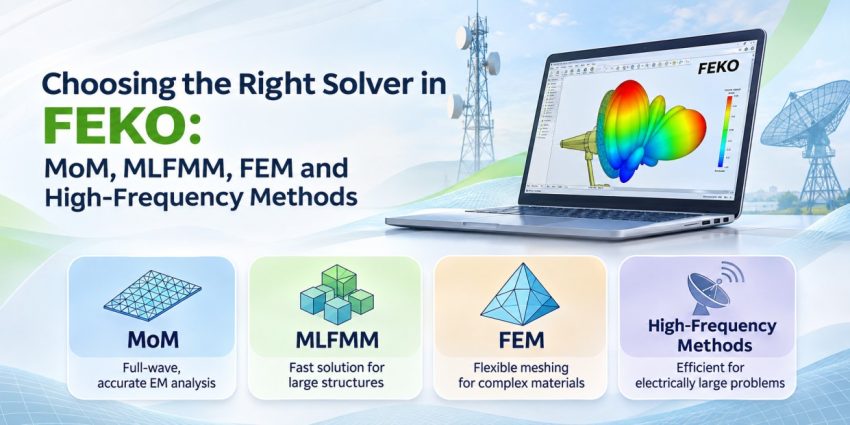
Choosing the Right Solver in FEKO: MoM, MLFMM, FEM and High-Frequency Methods

Posted on November 2, 2026November 4, 2026 by Trident Techlabs Limited

Electromagnetic simulation is more challenging for antenna design as size, frequency, and materials increase. Several solutions are provided by Altair Feko such as Method of Moments (MoM), Multilevel Fast Multipole Method (MLFMM), Finite Element Method (FEM), and high frequency techniques. Solver choice varies depending on the electromagnetic problem, electrical size, materials, required accuracy, and available computer power.

Start with Electromagnetic Problem

Solver choice should be made starting from understanding of the problem rather than making a particular technique choice. The frequency of operation is one of the considerations since wavelength is getting smaller as frequency increases. Thus, the same physical structure can have different electrical sizes depending on frequency.

Electrical size affects number of unknowns, electromagnetic coupling, memory, and simulation time. So, engineers should evaluate electrical size of their structures taking into account the wavelength.

MoM for Full-Wave Analysis

The Method of Moments (MoM) is a full-wave technique that is often used to analyze antennas and conducting structures. This method can solve for unknown currents and provide information about radiation, current distribution, and electromagnetic interaction.

A single antenna or small conducting structure may be appropriate for use with the MoM when it requires detailed full-wave analysis. But as the model increases in electrical size, it becomes computationally more challenging.

This aspect becomes especially important in the case of moving from one antenna to a larger array because electromagnetic interactions become many times more than with the single one.

MLFMM for Large Full-Wave Problems

The MLFMM is supposed to improve the efficiency of full-wave analysis for electrically large problems. By organizing the electromagnetic interactions, MLFMM reduces the computational effort necessary for large models.

For instance, the single broadband Vivaldi antenna is manageable in terms of computations in the traditional full-wave environment. If we increase the model to the 32-element array, then the problem becomes much harder.

In this situation, MLFMM should be considered when detailed full-wave analysis is needed for the electrically large problem. Thus, the decision depends on both model size and the need to retain full-wave electromagnetic analysis.

FEM for Complex Material Structures

Finite Element Method (FEM) is based on the volumetric technique which involves splitting regions of interest into small elements and computing electromagnetic fields in these elements. As a result, FEM is used if the volume behavior of dielectric/material regions is significant for the problem being simulated.

Many conducting antenna problems can be addressed using MoM or MLFMM. But when the detailed behavior of complex volumetric materials has to be modeled, FEM can be used.

It depends on the part of the electromagnetic behavior that has to be captured.

High-Frequency Methods for Large Structures

As a structure starts to span many wavelengths, full-wave analysis might start to require heavy computation resources. High-frequency techniques will offer an alternative approach as long as the assumptions used fit the problem at hand.

Feko offers high-frequency techniques such as Physical Optics (PO) and Ray Launching Geometrical Optics (RL-GO). These are techniques that employ approximations to make computations of electrically large structures less resource-demanding.

For instance, the analysis of a large conducting surface using a full wave technique can be challenging. A suitable high-frequency technique will have to be used as long as the complete analysis of the entire structure is not needed.

But speed of computation cannot be the sole deciding factor in choosing an appropriate approach. The chosen approach has to suit the physics of the problem.

Solver Selection as a Design Evolves

The solver choice may vary as a design evolves. Take a broadband Vivaldi antenna. The antenna itself may need to undergo full-wave modeling at the beginning. When it evolves into a large array, the emphasis starts shifting towards computational efficiency. After the array is mounted on an electrically large airborne vehicle, things get really complicated.

In this case, full-wave modeling would be needed for the antenna, while high-frequency techniques could be used for certain portions of the surrounding structure.

This example clearly demonstrates that the solver choice is not always a one-time decision.

Key Questions for Solver Selection

Engineers must ask themselves the following before picking a solver:

  • What is the frequency and the wavelength of operation?
  • How big is the structure compared to the wavelength?
  • Does it require a full wave analysis?
  • Are there complex materials in the problem domain?
  • How many elements and electromagnetic interactions are there?
  • Is the model electrically large?
  • How much computational power do you have?
  • Would a high-frequency approximation suffice?

Conclusion

Selection of a proper solver in Altair Feko involves considering the balance between electromagnetic needs and computation efficiency. While MoM can be used for many electromagnetic full-wave antenna and conducting structure problems, MLFMM can be used for larger full-wave problems. FEM can be used when there are considerations of volume material properties, while PO and RL-GO can solve suitable electrically large problems.

It is not the objective to select the fastest or the most advanced solver but one that satisfies all electromagnetic physics, electrical size, accuracy, and computation efficiency of the problem.

Frequently Asked Questions

Which solver should I use in Altair FEKO?

Choose MoM for standard antenna simulations, MLFMM for electrically large models, FEM for complex materials, and high-frequency methods for suitable large structures.

What is the difference between MoM and MLFMM in FEKO?

MoM calculates detailed electromagnetic interactions, while MLFMM groups interactions to reduce computational requirements for larger models.

Which FEKO solver is best for antenna simulation?

MoM is suitable for detailed full-wave antenna analysis, while MLFMM is generally more efficient for electrically large antennas and arrays.

When should I use FEM instead of MoM in FEKO?

Use FEM when complex dielectric materials or detailed electromagnetic field behavior inside volumes must be analyzed.

Which FEKO solver is suitable for large antenna arrays?

MLFMM is suitable for large antenna arrays requiring full-wave analysis with reduced memory and computational demands.

What are high-frequency methods in Altair FEKO?

High-frequency methods, including Physical Optics (PO) and Ray Launching Geometrical Optics (RL-GO), approximate electromagnetic behavior in electrically large structures.

How does frequency affect solver selection in FEKO?

Higher frequencies reduce wavelength, increasing a structure's electrical size and potentially changing solver efficiency and computational requirements.

Can FEKO combine different solvers in one simulation?

Yes, FEKO supports hybrid solver techniques to analyze detailed antenna regions alongside larger structures efficiently.

How can I reduce simulation time in Altair FEKO?

Use MLFMM for large full-wave models or suitable high-frequency approximations to reduce computation without overlooking essential electromagnetic behavior.

What factors should I consider when choosing a FEKO solver?

Consider operating frequency, electrical size, material complexity, accuracy requirements, electromagnetic interactions, and available computing resources.

Also Read: How PCB Design Services Near Me Can Help Reduce Product Development Time

1 thought on “Choosing the Right Solver in FEKO: MoM, MLFMM, FEM and High-Frequency Methods”

  1. Pingback: How CAM350 Helps Connect PCB Design and Manufacturing

Leave a Reply Cancel reply

Your email address will not be published. Required fields are marked *

Send Query

    Recent Posts

    • PCB Design: When “Perfectly Routed” Doesn’t Mean “Perfectly Working”
    • How CAM350 Helps Connect PCB Design and Manufacturing
    • Choosing the Right Solver in FEKO: MoM, MLFMM, FEM and High-Frequency Methods
    • How PCB Design Services Near Me Can Help Reduce Product Development Time
    • How PCB Manufacturing Companies in India Can Reduce Design Errors Before Fabrication

    Recent Comments

    1. PCB Design: When “Perfectly Routed” Doesn’t Mean “Perfectly Working” on How CAM350 Helps Connect PCB Design and Manufacturing
    2. How CAM350 Helps Connect PCB Design and Manufacturing on Choosing the Right Solver in FEKO: MoM, MLFMM, FEM and High-Frequency Methods
    3. Choosing the Right Solver in FEKO: MoM, MLFMM, FEM and High-Frequency Methods on How PCB Design Services Near Me Can Help Reduce Product Development Time
    4. How PCB Design Services Near Me Can Help Reduce Product Development Time on How PCB Manufacturing Companies in India Can Reduce Design Errors Before Fabrication
    5. How PCB Manufacturing Companies in India Can Reduce Design Errors Before Fabrication on Hidden Weaknesses in Hardware: Finding Vulnerabilities Before Silicon

    Archives

    • November 2026
    • October 2026
    • September 2026
    • August 2026
    • July 2026
    • June 2026
    • May 2026
    • April 2026
    • March 2026
    • February 2026
    • January 2026
    • December 2025
    • November 2025
    • October 2025
    • September 2025
    • August 2025
    • July 2025
    • June 2025
    • May 2025
    • April 2025
    • March 2025
    • February 2025
    • January 2025
    • December 2024
    • November 2024
    • October 2024
    • September 2024
    • August 2024
    • July 2024
    • June 2024
    • May 2024
    • April 2024
    • March 2024
    • February 2024
    • January 2024
    • December 2023
    • November 2023
    • October 2023
    • September 2023
    • August 2023

    Categories

    • ARC Flash
    • Arc Flash Risk Assessment
    • ASIC Design and Implementation
    • CAE
    • CAM
    • Cybersecurity
    • Electric Arc
    • Electronics Engineering
    • FPGA Design and Validation
    • Mechanical Engineering
    • PCB Design
    • Power Integrity
    • Reliability Analysis
    • Reliability and Quality Solutions
    • Safety Assessment
    • Semiconductor Solutions
    • Signal Integrity
    • software provider
    • Structural Analysis
    • Thermal Design

    Our Certificates

    • CMMI Level 3
    • Information Security Management System (ISO 27001:2022)
    • Quality Management System (ISO 9001:2015)
    • Information Technology Service Management (ISO/IEC 20000-1:2018)
    • Occupational Health & Safety Management System (ISO 45001:2018)

    Our Services

    • Engineering Solutions
    • Power System Solutions
    • Cybersecurity Solutions
    • Semiconductor Services

    Quick Links

    • Home
    • Company Overview
    • Investor Charter
    • Events
    • Blogs
    • Contact Us
    • Privacy Policy

    Trident Techlabs Limited

    • White House, 1/18-20, 2nd Floor, Rani Jhansi Road, New Delhi - 110055
    • +91-11-61811100
    • corporate@tridenttechlabs.com

    © All Copyright 2026 by Trident Techlabs

    imunify-bot-check