


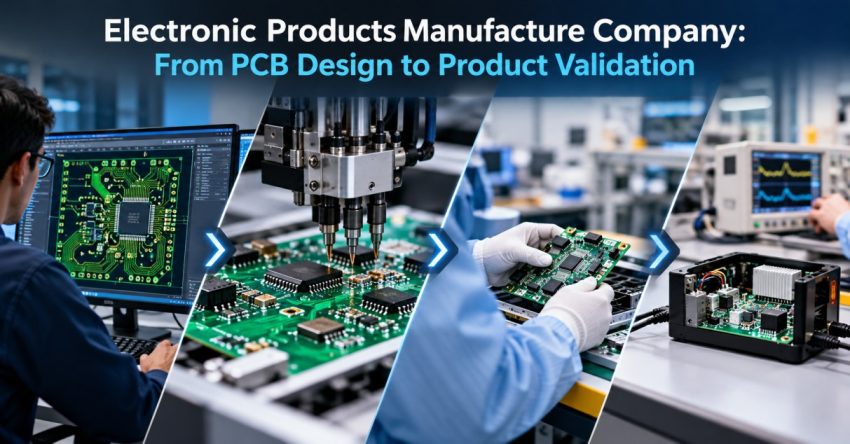
It takes more than component assembly and a circuit board to develop a reliable electronic product. All phases of the process from initial design through to final validation have an impact on how the product will behave in real world applications. When designing an electronic product, an electronic products manufacture company will need to rely on electrical performance, component compatibility, manufacturability and reliability as some of the factors that can help ensure that the product meets its intended requirements.
Engineering support can be useful for businesses that are building complex electronic systems, as it can help to identify design problems early on and save on expensive revisions that could be required later in the product development lifecycle.
PCB Design: Establishing the Foundation
Printed Circuit Board (PCB) design is a key phase in the creation of an electronic product. Electrical performance can be directly impacted by the placement of components, routing of traces, material selection and layering of boards.
Signal integrity, controlled impedance, crosstalk and return paths are also important considerations for high-speed applications. A PCB can complete the basic Design Rule Check (DRC), but still perform poorly during operation due to signal distortion or timing problems.
Careful design reviews and simulation can be used to uncover potential issues before the board decides to go into manufacturing. This creates a critical requirement for PCB design for product performance and reliability.
Selecting and verifying components.
The choice of electronic components must consider more than just cost and availability. Final design may be affected by operating temperature, power requirements, electrical properties, and life availability as well as compatibility with other components.
Design verification may be used to determine if the hardware functions as required. Engineers can use simulation and formal verification techniques or other analysis techniques in their application, to analyze the behaviour of the circuit and to find potential weaknesses in the circuit.
These activities can be used to detect functional errors and design vulnerabilities in products with complex hardware or semiconductor devices before physical production.
Why is Simulation so Important Prior to Manufacturing?
Using simulation, engineers can test the behaviour of their design under various operating conditions without having to construct the entire design. Depending on the instruments and models employed, it can be used for investigating electrical performance, thermal behaviour and other engineering aspects.
Early analysis can be used to compare design options, to determine potential failure points, and to make choices before fabrication occurs.
In addition to being able to help coordinate the design requirements and manufacturing constraints, simulation and verification can also be beneficial for an electronic products manufacture company that works with more complex designs.
Product Validation: Moving Beyond Design Completion
A finished design is not necessarily a sure product. Product validation is the process of assessing the functionality of the developed hardware in the conditions of operation specified by the product.
Validation activities can be:
- Functional testing to validate that the product functions as intended.
- Electrical testing to determine performance and compliance to design.
- Environmental testing to assess behaviour in appropriate temperature, humidity and/or vibration.
- Reliability testing for determination of durability and failure mechanism.
The relevant tests will vary depending on the product, the environment in which it operates and industry requirements. The results of the validation can inform corrective actions before the product is released.
Connecting Engineering and Manufacturing
Structured development process links PCB design, component selection, verification, simulation and product validation. If these activities are viewed collectively, the teams can anticipate problems sooner; minimize design iterations and increase its confidence in the final product.
Trident Techlabs enables engineering-centric industries by providing solutions in various domains like semiconductor design, simulation and verification. These capabilities can help solve complex electronic design issues prior to manufacturing and deployment.
Conclusion
When selecting an electronic products manufacture company, one should assess the capability of the company to take care of a design and engineering concerns throughout an item’s development. PCB design lays the groundwork, functional requirements are verified, product performance is simulated and then validated to demonstrate that the product will achieve its intended goals.
Systematic handling of these stages can help minimize development risks that businesses can avoid and support the production of electronic products that are functional, reliable and suitable for the intended application.