


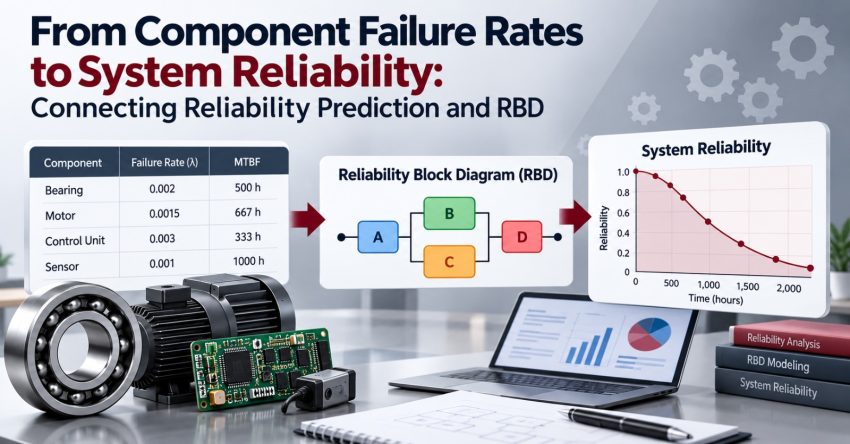
A product’s reliability depends on more than the performance of its individual components. A product whose components have attained the required level of reliability could exhibit some peculiarities when the way they work together is considered. Therefore, it is crucial to get an understanding of this relationship for better design and performance.
Reliability Prediction and RBD analysis are two methods used by engineers for assessing the reliability of a product in terms of the components and the whole system.
Reliability Prediction: Estimating the Performance of Components
Reliability Prediction involves estimating the chances of failures of components or sub-systems through such factors as component features, operational environment and prediction models.
It allows engineers to make a judgment about such parameters as:
- Failure rates of components and sub-systems
- Time between failures
- Reactivity under certain conditions
- Contribution of components to failure
This allows one to detect possible reliability problems during the design stage without using enough field data. For different applications, engineers could choose the following well-known methodologies – MIL-HDBK-217, Telcordia and SN 29500.
Linkage Between Component-Level Estimates and RBD Analysis in terms of System Reliability
Component-level reliability estimates are the basic building block of reliability analysis, however, they cannot alone explain how the whole system will behave. The architecture of the system also plays an important role and affects the performance of the system in case of component failure.
Reliability Block Diagram reflects the functional dependence of components and sub-components. With the help of RBD analysis, engineers can determine how these dependencies influence the reliability and availability of the whole system.
For instance, in a series connection, the failure of any vital component results in the failure of the whole system. While in a parallel connection, redundant components might enable the system to operate normally even in case of component unavailability.
RBD can also illustrate the hot, cold and warm standby architectures and help compare different architectural schemes.
Connecting Reliability Prediction with RBD Analysis
It is when these two techniques are utilized together that the real power comes out. Reliability Prediction gives information on component failures whereas RBD uses this information to evaluate system level performance.
This association makes it possible for engineers to get an insight into how the failure rate of individual components impacts the overall reliability of the system. In addition, this technique enables what if analysis through which one can determine the impact of making changes to a system such as adding redundancy.
In the Relyence software, RBD models may utilize information from Reliability and Maintainability Predictions. This implies that updates made to the information in predictions can impact system level analyses.
Supporting Reliability Engineering Throughout Product Development
The integration of reliability engineering is beneficial through out the entire life-cycle of the product.
At the initial stages of designing, engineers can lay down preliminary reliability objectives. At the stage of developing the design, engineers can use the more accurate component data for conducting the analysis. The design reviews can be used to evaluate the alternatives. Testing and validation of the design can also help to make an assessment of the predicted performance.
This way it is possible to detect the vulnerabilities earlier and take necessary actions prior to products going to the market.
Relyence Studio combines Reliability Prediction and RBD with many other reliability and quality analysis tools. Thanks to its partnership with Relyence, Trident Techlabs offers engineering solutions which are based on structured reliability practices.
Conclusion
Reliability Prediction allows estimating the expected behavior of the components and subsystems while RBD provides insights into the way their arrangement affects the reliability and availability of the whole system.
Thus by integrating these approaches companies can go beyond the estimates of the failure rates and get a deeper insight into the behavior of the system.
Frequently Asked Questions
Also Read: Electronic Products Manufacture Company: From PCB Design to Product Validation